Personal Records: What Actually Counts as a PR
8 min read · July 2026 · by Manikanta Sirumalla

Personal Records: What Actually Counts as a PR
The personal record is the most satisfying moment in training. It is proof, in a single number, that the work is paying off. But "PR" gets thrown around loosely, and a badge that fires every time you have a slightly good day quickly stops meaning anything. A well-defined PR is rare enough to be motivating and objective enough to be true. Here is how to think about what actually counts.
The Different Kinds of PR
Most people picture a PR as a heavier bar for a single rep. That is one type, but it is far from the only one, and for most lifters it is not even the most useful.
1-Rep Max PR. The classic: a heavier single than you have ever lifted. Meaningful, but you rarely test it, so it moves only a few times a year.
Rep PR. More reps at a weight you have used before. Going from 185x5 to 185x7 is a genuine strength improvement, even though the number on the bar did not change.
Volume PR. The most total work in a single session or week for a lift or muscle group (weight x sets x reps). This is the currency of hypertrophy and it moves often.
Estimated 1RM PR. A new best estimated one-rep max, computed from any working set. This is the quiet workhorse of PR tracking, because any hard set in a sensible rep range can produce one. A heavy triple, a rep-out, a new weight for 5, all of them can push your e1RM to a new high.
Why a True PR Needs a Margin
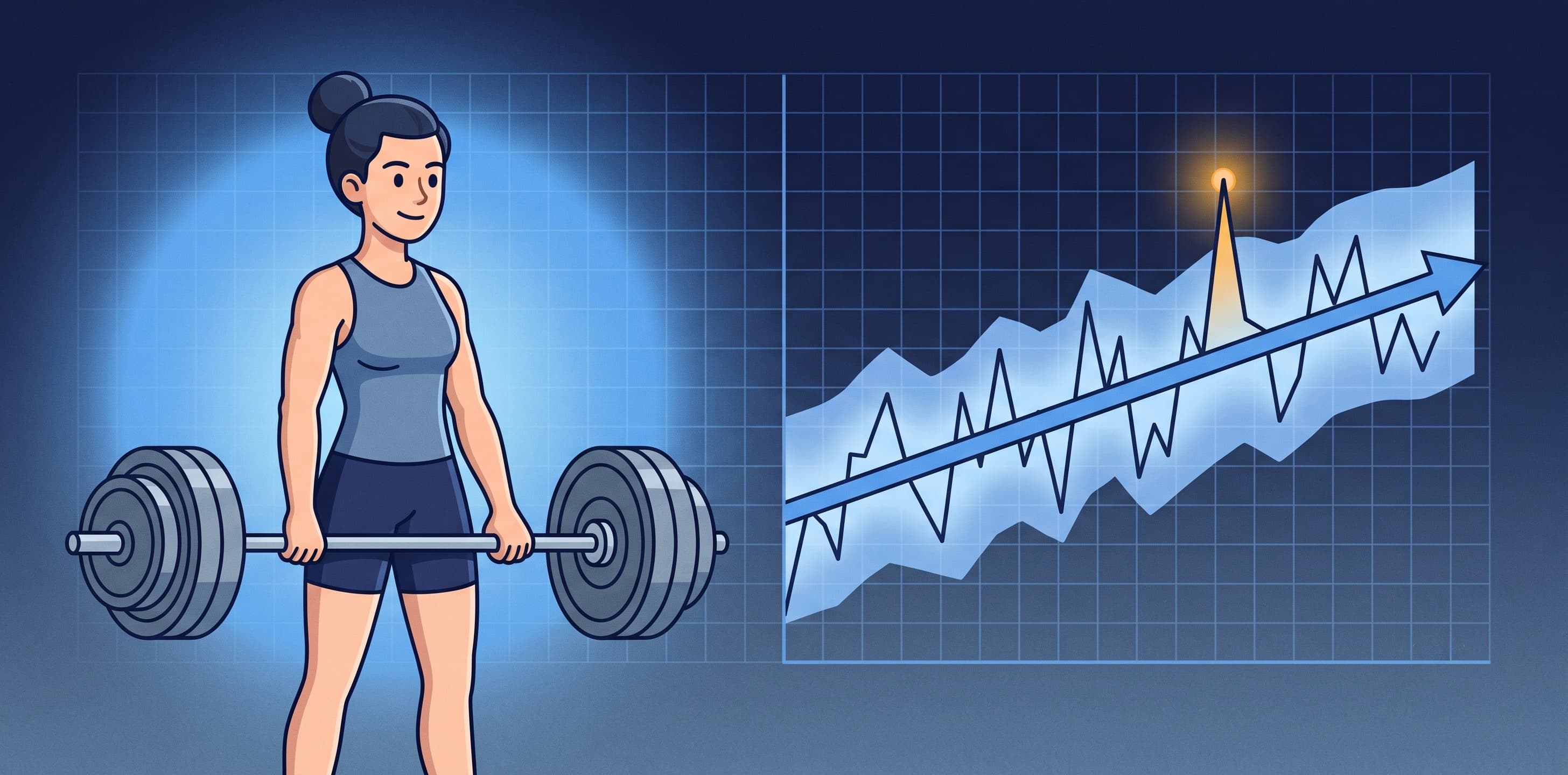
Here is the trap. If you define a PR as "any e1RM higher than the previous best," you will set a "PR" almost every session, because e1RM naturally wiggles up and down by a percent or two based on sleep, warm-up, hydration, and how hard you pushed. Tag every tiny uptick as a record and the badge becomes noise.
A real PR has to clear a margin over your previous best, a gap wide enough that it almost certainly reflects real improvement rather than a good-day fluctuation. RepTrack uses a 1.5% margin over your prior all-time-best e1RM before it awards a PR. If your best-ever bench e1RM is 220 lbs, a new set has to project to roughly 223.3 lbs or higher to earn the badge. A reading of 221 is a nice day, but it falls inside the noise band and does not count.
This is the same signal-versus-noise problem we cover in measuring real progress: the margin exists to protect the meaning of the record.
The All-Time-Best Baseline
Notice the phrase "all-time best." A PR is measured against the highest value you have ever posted on that lift, not against last week or last month. This matters for two reasons.
First, it prevents ratcheting. If PRs were measured against a recent rolling average, a lift that dipped during a deload and then returned to normal would fire a string of false "records" as it simply recovered lost ground. Anchoring to your all-time best means a PR is always genuinely new territory.
Second, it makes the badge honest during a comeback. Returning from a layoff, you might feel like you are PRing constantly as strength floods back, but until you exceed your previous best-ever, you are regaining, not breaking new ground. Both are worth celebrating, but they are not the same thing, and a good system does not confuse them.
PRs and Progressive Overload
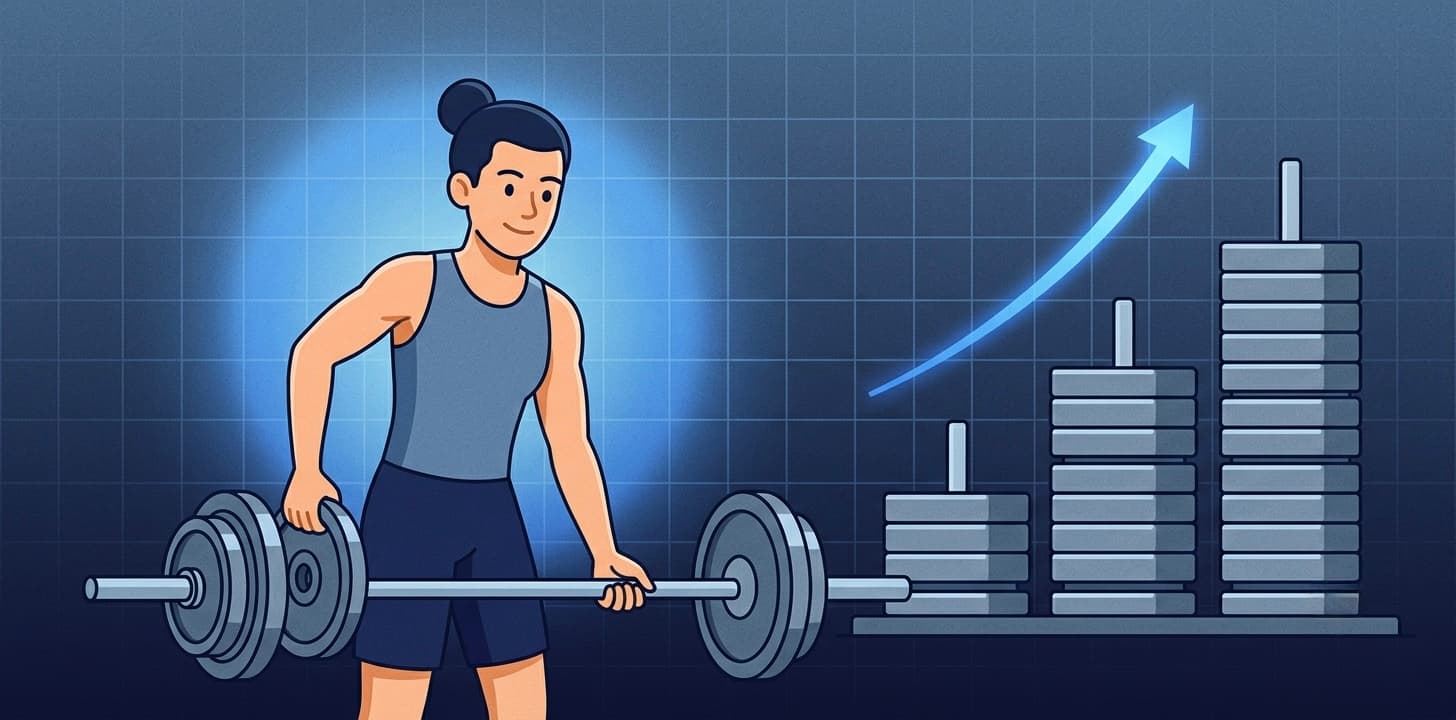
A personal record is what progressive overload looks like when it finally surfaces as a number. Overload is the slow, day-to-day accumulation of slightly more work; a PR is the visible peak that pokes above your previous high-water mark. This is why PRs get rarer as you advance, and that is completely normal.
| Training age | Realistic PR frequency |
|---|---|
| Beginner (0-1 yr) | Almost every week on the main lifts |
| Intermediate (1-3 yr) | Every few weeks, per lift |
| Advanced (3+ yr) | A handful of times per year, hard-won |
A beginner smashing weekly PRs and an advanced lifter fighting for two a year can both be training perfectly. The frequency of records is a function of training age, not of how good your program is. Judging an advanced block by beginner PR frequency is a fast route to unnecessary program-hopping.
How to Chase PRs Without Wrecking Yourself
The danger of loving PRs is that you start forcing them, grinding ugly reps and creeping loads before you have earned them. That is how form breaks down and joints complain.
Let them come from clean sets. A PR built on a rep you barely completed with a form breakdown is a worse strength signal than a slightly lighter set done well. Quality first.
Don't max every week to hunt singles. Because an estimated-1RM PR can come from a set of 3, 5, or 8, you can accumulate records without ever peaking. Let the e1RM do the work.
Expect dry spells. Blocks go by without a PR, especially during accumulation phases where you are building volume rather than expressing peak strength. A deload and the rebound that follows it often unlock the next one.
When You Should Not Trust a PR
A PR is only as good as the rep behind it. Discount it, or throw it out, when:
- Range of motion shrank. A half-depth squat "PR" is a new exercise, not a new record.
- Someone touched the bar. A spotter's fingertips turn your single into an assisted lift.
- Equipment changed. A stiffer bar, a fresh set of wraps, or a different squat shoe can flatter a number without any real strength gain.
- The rep count is inflated. A very high-rep set feeding a strength estimate is unreliable, which is exactly why capped e1RM ignores those reps.
Honesty here protects you. A PR you fudged is a baseline you now have to beat legitimately, and it quietly raises the bar on every future "record."
The Bottom Line
A personal record should be rare, clean, and measured against your all-time best with enough margin to rule out a lucky day. Defined that way, the badge becomes what it is supposed to be: undeniable proof that you are stronger than you have ever been. Track every type of PR, let them arrive from honest sets rather than forcing them, and accept that the further you go, the more precious and infrequent each one becomes.
That rarity is the point. A record worth breaking is a record worth respecting.