Plateaus: How to Know You've Stalled and Break Through
9 min read · July 2026 · by Manikanta Sirumalla
Plateaus: How to Know You've Stalled and Break Through
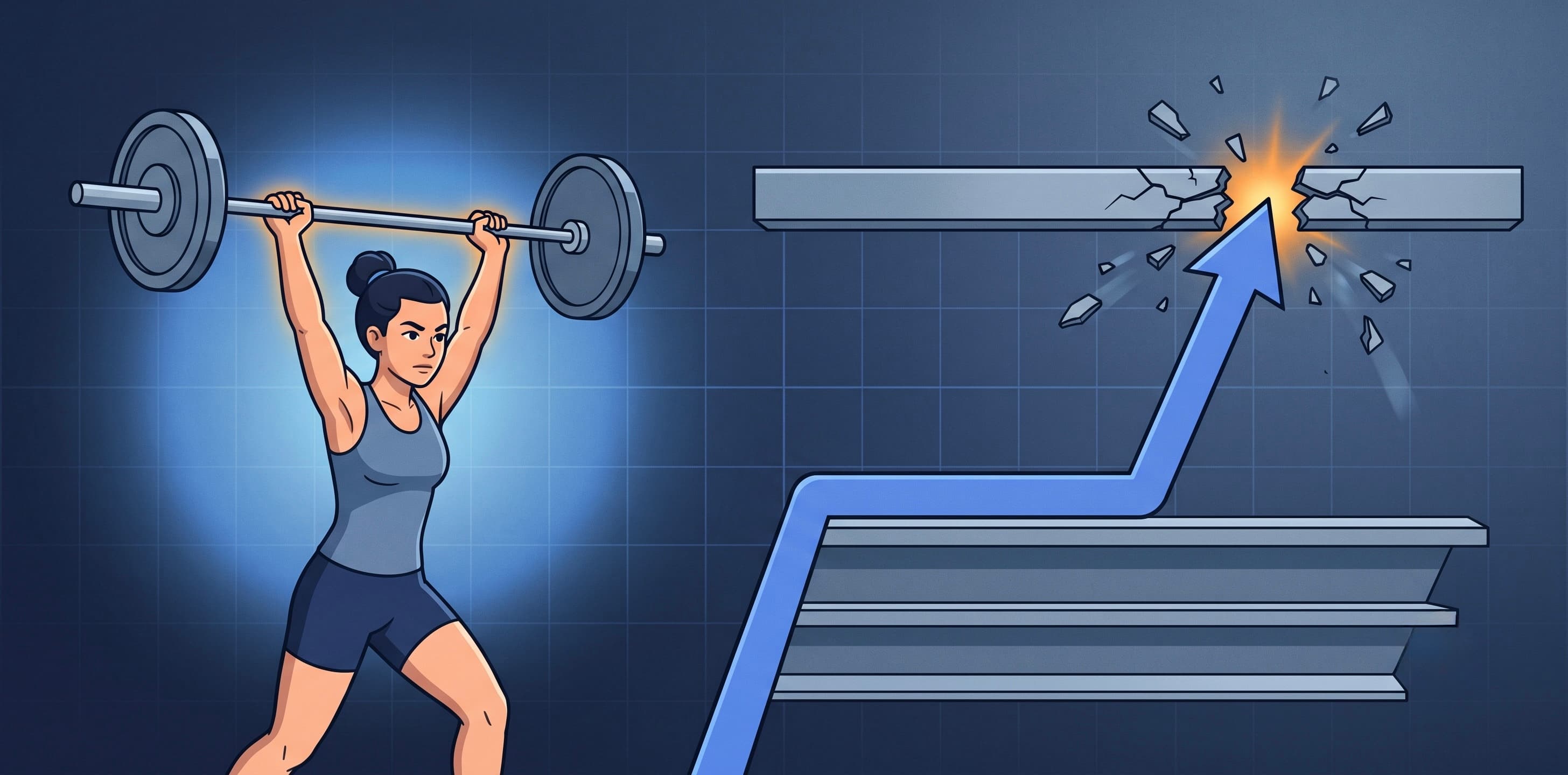
Everyone hits a wall eventually. The weights that climbed for months stop moving, the sessions feel the same, and the progression chart flattens. The instinct is to panic and change everything. The better response is to first ask a colder question: is this actually a plateau, or just a bad couple of weeks? Most "plateaus" people react to are noise. The real ones have a signature, and once you can recognize it, the fix follows a clear order.
A Bad Day Is Not a Plateau
Strength fluctuates constantly. Sleep, stress, hydration, meal timing, warm-up quality, even the weather in the gym all move your output by a few percent on any given day. Your estimated 1RM inherits every bit of that variability. So a single flat or down session tells you almost nothing.
A plateau is not "I didn't PR today." A plateau is a sustained failure to progress, confirmed across both enough sessions and enough calendar time that it cannot be explained by a rough patch.
This is why a good detector waits for two conditions at once. RepTrack flags a stall only when a lift's e1RM has failed to progress by more than 3% across at least 3 sessions AND at least 4 weeks. Both clocks have to run out. Three flat sessions crammed into one hard week is likely just fatigue; three flat sessions spread across five weeks is a genuine stall. Requiring both guards prevents the two classic false alarms: the fatigue dip (many sessions, little time) and the slow trainer (little data, lots of time).
Single-Lift vs Systemic Stalls
Before you reach for a fix, notice how many lifts have stalled. The answer changes the diagnosis entirely.
A single lift stalls. Your bench is stuck but your squat, deadlift, and rows are all still climbing. This is almost always specific: a technique flaw at a sticking point, a lagging muscle in the chain, or an exercise you have simply adapted to. The fix is local.
Several lifts stall at once. Your bench, squat, and pulls all flatten in the same window. This is rarely a coincidence and almost never a technique problem on three lifts simultaneously. A systemic stall points at recovery: you are under-sleeping, under-eating, or accumulating fatigue faster than you are dissipating it. The fix is global, and it usually starts with rest, not with adding work.
Getting this distinction right saves you from the most common mistake in all of training: responding to a recovery problem by adding more training.
The Ladder of Fixes
When you have confirmed a real stall, work through these interventions in order. Do not jump to the bottom of the ladder first; the early rungs are cheaper, safer, and fix the majority of cases.
Rung 1: Deload
Nine times out of ten, the first thing a stalled lifter needs is less, not more. Accumulated fatigue masks fitness. A planned deload week, cutting volume or intensity by roughly 40-50% for a week, lets that fatigue drain so your true strength can resurface. Performance typically rebounds a few percent above pre-deload levels afterward. If you have been training hard for 4-6 weeks and stall, deload before you touch anything else.
Rung 2: Add or Redistribute Volume
If a deload and its rebound do not restart progress, the lift may genuinely need more stimulus. Add a set or two per session, or add a weekly frequency (training the lift twice a week instead of once). This is the progressive overload lever most people forget, because they equate overload with adding weight and nothing else. More quality sets is often what an intermediate lift needs to move again.
Rung 3: Change a Variable
Still stuck? Change one input and hold the rest constant so you can read the result. Options:
- Rep range. If you have been grinding heavy triples, spend a block at 8-12 to build work capacity, then return to heavy.
- Rest periods. Too-short rests can cap your top sets; adding 60-90 seconds sometimes unlocks a stalled compound.
- Tempo. A controlled eccentric can drive new adaptation at the same load.
Change one thing at a time. Change five and you will never know which one worked.
Rung 4: Rotate the Variation
If the exact same movement has been stalled for a long stretch, swap it for a close cousin for a block: incline press for flat bench, front squat for back squat, deficit deadlift for conventional. The new stimulus restarts progress and usually strengthens the sticking point that stalled the original. After a block, return to the main lift, and it often jumps.
The Causes Underneath
The ladder treats the stall; it helps to understand what usually causes it in the first place.
| Cause | Tell | Where it sits on the ladder |
|---|---|---|
| Under-recovery | Multiple lifts flat, poor sleep, low drive | Rung 1 (deload) |
| Insufficient volume | One lift flat, everything feels easy | Rung 2 (add volume) |
| Nutrition gap | Stall alongside no bodyweight change on a bulk, or a steep cut | Fix diet first |
| Adaptation to a stimulus | One lift flat for a long time, no other symptoms | Rungs 3-4 (change/rotate) |
| Technique breakdown | Fails at the same sticking point every time | Coaching + rung 4 |
Notice that two of these, recovery and nutrition, are not training problems at all. You cannot add-set your way out of five hours of sleep or a chronic protein deficit. This is why systemic stalls start with life, not with the program.
Don't Break Something That Isn't Broken
The final rule is the hardest for motivated people: if the trend is still climbing, do nothing. A jagged, sawtooth progression line that slopes upward is not a plateau, it is normal training. Reacting to every down-week by changing the program is how people sabotage working plans. The whole reason a detector demands multiple sessions and multiple weeks is to keep you from intervening on noise.
Patience is a training variable. The lifters who progress the most are usually the ones who change the least, only acting when a stall is genuinely confirmed, and then acting in order rather than in panic.
The Bottom Line
A plateau is a sustained, confirmed stall, not a bad session and not a rough week. Check whether it is one lift or many: single-lift stalls are usually stimulus or technique, systemic stalls are usually recovery. Then climb the ladder in order, deload, add volume, change a variable, rotate the variation, stopping at the first rung that gets you moving again. And when the line is still trending up, keep your hands off it. The wall is real, but it almost always has a door, and it is usually the first one you try.