How to Warm Up Properly (And Why Most People Skip It)
7 min read · April 2025 · by Manikanta Sirumalla
How to Warm Up Properly (And Why Most People Skip It)
A 2010 study in the British Journal of Sports Medicine reviewed 46 trials on warm-up protocols and found that performance improved in 79% of criteria examined. The average improvement: 5-10% on power output, sprint times, and maximal strength. A separate meta-analysis in the Scandinavian Journal of Medicine and Science in Sports showed that structured warm-ups reduced overall injury risk by roughly one-third. Those are meaningful numbers. A 5% improvement on a 300 lb squat is 15 lbs — a gain that would normally take an intermediate lifter weeks to earn through progressive overload alone.
And yet, the most common warm-up in commercial gyms is still "do a few arm circles, load the working weight, and hope for the best." Or worse: walk in, sit down at the bench, and start pressing.
The warm-up is not filler. It is the highest-value 10 minutes of your workout.
Why Warming Up Works: The Physiology
Three things happen in your body during an effective warm-up, and all three directly improve performance.
1. Core temperature rises. Muscle temperature increases by 1-2 degrees Celsius during a proper warm-up. Warmer muscles contract more forcefully, relax more quickly, and have greater elastic energy storage. Nerve conduction velocity increases by approximately 2.4% per degree of temperature increase — which means faster motor unit recruitment and more explosive force production. This is not marginal. The difference between a "cold" nervous system and a warm one is the difference between a sluggish first set and a crisp, powerful one.
2. Synovial fluid circulates. Your joints are lubricated by synovial fluid, which becomes less viscous (thinner and more slippery) as it warms up. Cold joints have higher internal friction, which means more stress on cartilage and connective tissue under load. Five to ten minutes of movement distributes this fluid across joint surfaces — particularly important for the knees, hips, and shoulders, which bear the highest loads during compound exercises.
3. Neural pathways prime. Your nervous system needs rehearsal before it performs optimally. The motor patterns for a heavy squat involve coordinated firing of dozens of muscles in precise sequences. Ramp-up sets with progressively heavier loads allow your nervous system to "rehearse" the movement pattern at lower intensities before the demands become maximal. This is called post-activation potentiation (PAP), and it is the reason your second or third working set often feels stronger than your first — your nervous system is finally fully online.
The Three-Phase Warm-Up Protocol
An effective warm-up has three distinct phases. Skipping any one of them leaves performance on the table.
Phase 1: General Warm-Up (3-5 Minutes)
The goal here is simple: raise your core temperature and heart rate. You should break a light sweat but not be breathing hard. This is not a cardio workout — it is a thermostat adjustment.
Options (pick one):
- Brisk walking on an incline treadmill (10-15% grade, 3.5-4.0 mph)
- Light rowing (under 2:30/500m pace, steady effort)
- Stationary bike (moderate resistance, 70-80 RPM)
- Jump rope (moderate pace, no double-unders)
The specific modality does not matter much. What matters is that it involves large muscle groups and gets blood flowing systemically. Five minutes is sufficient for most people. If you train in a cold gym or first thing in the morning, extend to 7-8 minutes — your baseline temperature is lower and it takes longer to reach the threshold.
Phase 2: Dynamic Stretching (3-5 Minutes)
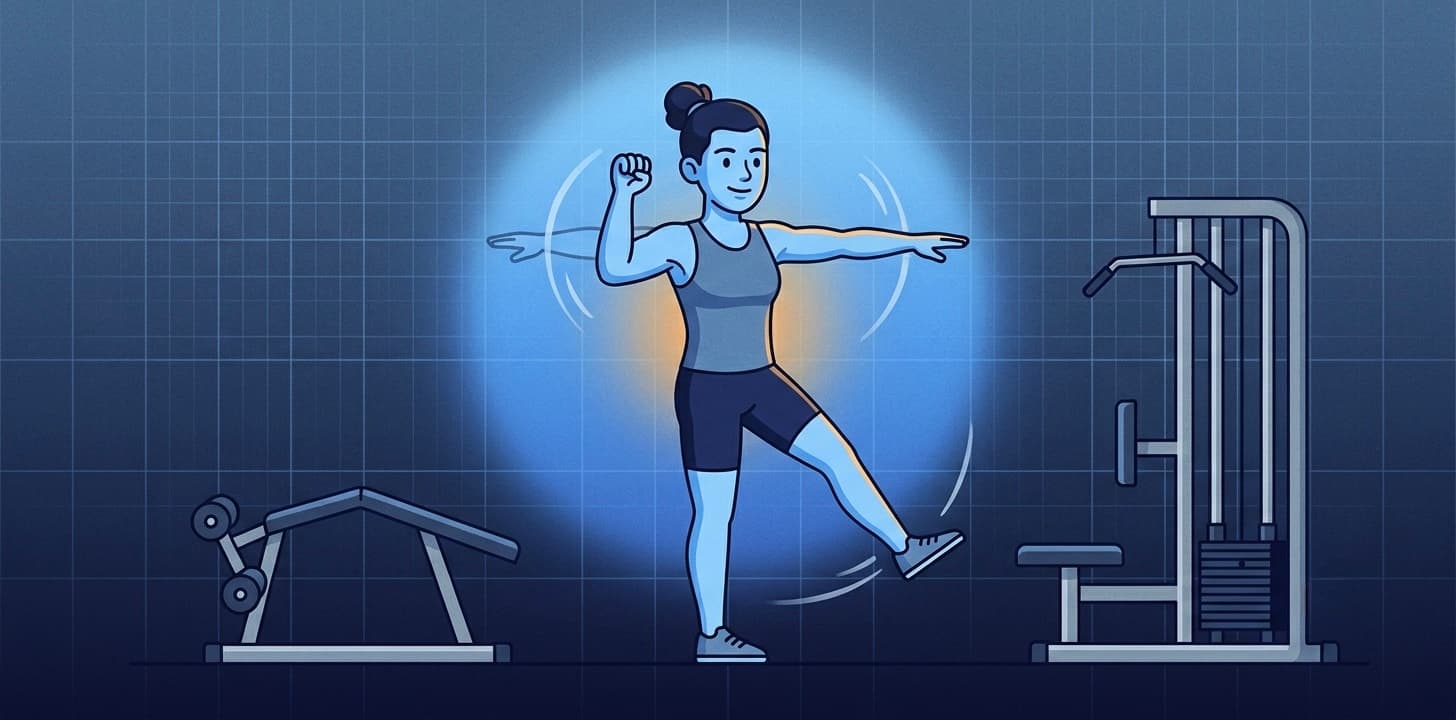
Dynamic stretching involves moving a joint through its full range of motion in a controlled, repetitive manner. It is not bouncing. It is not forcing range. It is actively taking your joints through the ranges they will need during your workout.
Dynamic stretching accomplishes two things that the general warm-up does not: it increases range of motion at specific joints (temporarily, by 5-10%) and it activates stabilizer muscles that may be underactive from sitting all day.
Upper body dynamic stretches:
- Arm circles (forward and backward): 10 each direction
- Band pull-aparts: 15 reps
- Wall slides (slide your arms up and down a wall while keeping contact): 10 reps
- Thoracic rotations (on all fours, rotate one arm up toward the ceiling): 8 per side
Lower body dynamic stretches:
- Leg swings (forward/back and lateral): 10 each direction per leg
- Walking lunges with a torso twist: 8 per side
- Hip circles (standing on one leg, draw large circles with the opposite knee): 10 per leg
- Inchworms (walk your hands out to a push-up position, walk feet to hands): 6 reps
- Bodyweight deep squat hold: 15-20 seconds, gently push knees out with elbows
Choose 4-5 stretches that target the joints you will load that day. A push day warm-up prioritizes shoulders and thoracic spine. A leg day warm-up prioritizes hips, knees, and ankles. A pull day needs shoulder and hip mobility (for deadlift variations and rows).
Phase 3: Specific Warm-Up — Ramp-Up Sets (3-5 Minutes)
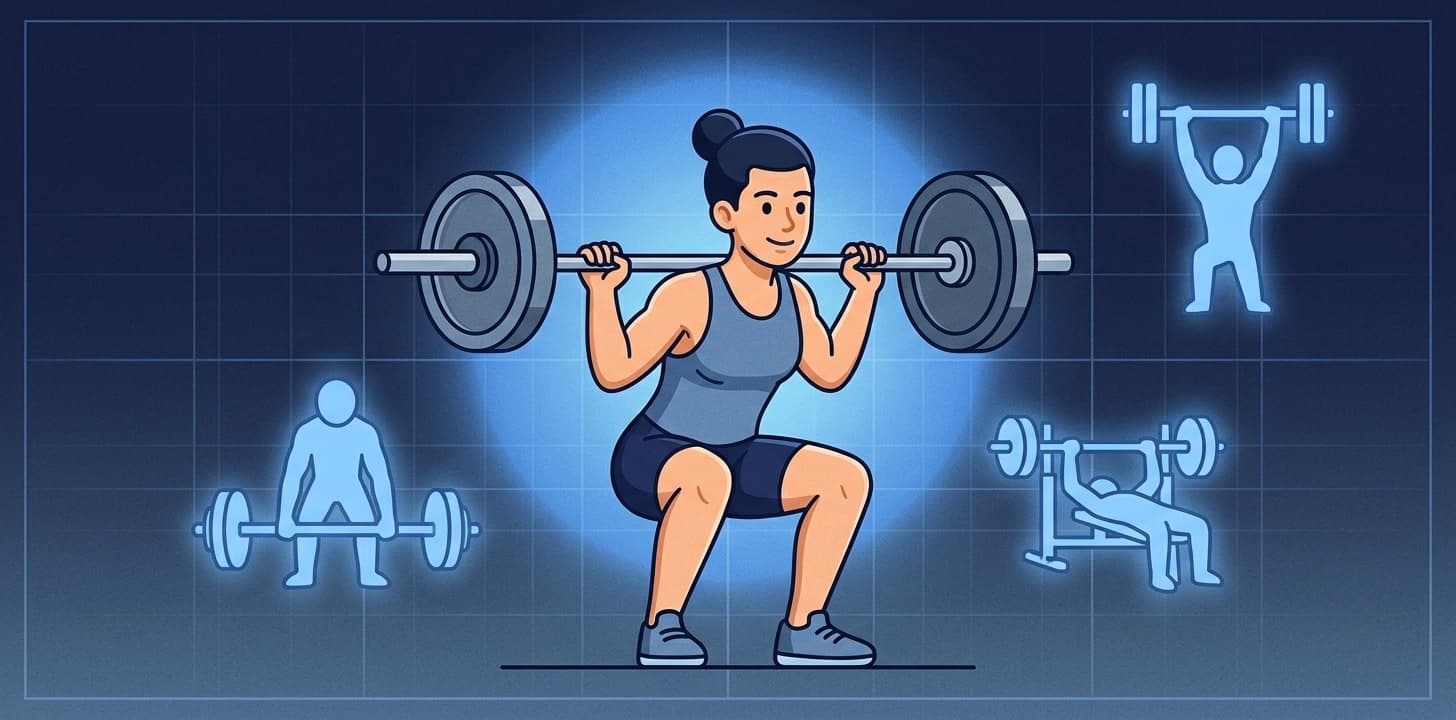
This is the most important phase and the one people most often butcher. Ramp-up sets are progressively heavier sets of your first exercise, building from very light to your working weight. They serve as the final bridge between a warm body and maximal performance.
The protocol is straightforward. If your working weight for barbell squats is 275 lbs:
| Set | Weight | Reps | Purpose |
|---|---|---|---|
| Ramp 1 | Empty bar (45 lbs) | 10 | Movement pattern rehearsal |
| Ramp 2 | 135 lbs (50%) | 6 | Groove the pattern under moderate load |
| Ramp 3 | 185 lbs (67%) | 4 | Neuromuscular activation |
| Ramp 4 | 225 lbs (82%) | 2 | Post-activation potentiation |
| Ramp 5 | 255 lbs (93%) | 1 | Final prime |
| Working set 1 | 275 lbs | Target reps | Full performance |
Notice the rep counts decrease as weight increases. Ramp-up sets should never be fatiguing. Their purpose is activation and rehearsal, not work. If you are out of breath or feeling muscular fatigue from your warm-up sets, you did too many reps.
Ramp-up guidelines by working weight:
- Working weight under 135 lbs: 2-3 ramp-up sets are sufficient
- Working weight 135-225 lbs: 3-4 ramp-up sets
- Working weight 225-315 lbs: 4-5 ramp-up sets
- Working weight above 315 lbs: 5-6 ramp-up sets
The heavier you work, the more ramp-up sets you need. A 500 lb deadlifter cannot jump from 135 to 500. The neural and connective tissue preparation requires more gradual loading.
Sample Warm-Ups by Workout Type
These are complete warm-up protocols you can use immediately. Total time for each: 8-12 minutes.
Push Day Warm-Up
If your main lift is the bench press, your warm-up needs to prepare the shoulders, chest, and triceps.
- General: 3-4 min incline walking or light rowing
- Dynamic stretches (2-3 min):
- Arm circles: 10 forward, 10 backward
- Band pull-aparts: 15 reps
- Wall slides: 10 reps
- Push-up to downward dog: 6 reps
- Ramp-up sets for bench press: Empty bar x 10, 50% x 6, 70% x 4, 85% x 2, then working sets
Pull Day Warm-Up
Main lifts typically include barbell rows and/or deadlift variations. The hips, hamstrings, lats, and shoulders all need preparation.
- General: 3-4 min rowing machine (light pace)
- Dynamic stretches (2-3 min):
- Band pull-aparts: 15 reps
- Cat-cow stretches: 8 reps
- Thoracic rotations: 8 per side
- Hip hinges with a dowel (practice the hinge pattern): 10 reps
- Ramp-up sets for barbell row or deadlift: Empty bar x 10, 50% x 6, 70% x 4, 85% x 2, then working sets
Leg Day Warm-Up
Squats and their variations demand the most thorough warm-up. The hips, knees, and ankles all operate under heavy load through large ranges of motion.
- General: 4-5 min incline walking or stationary bike
- Dynamic stretches (3-4 min):
- Leg swings (front/back): 10 per leg
- Leg swings (lateral): 10 per leg
- Walking lunges with twist: 8 per side
- Bodyweight deep squat hold: 20 seconds
- Glute bridges: 10 reps (activates glutes, which are often "asleep" from sitting)
- Ramp-up sets for squat: Empty bar x 10, 50% x 6, 65% x 4, 80% x 2, 90% x 1, then working sets
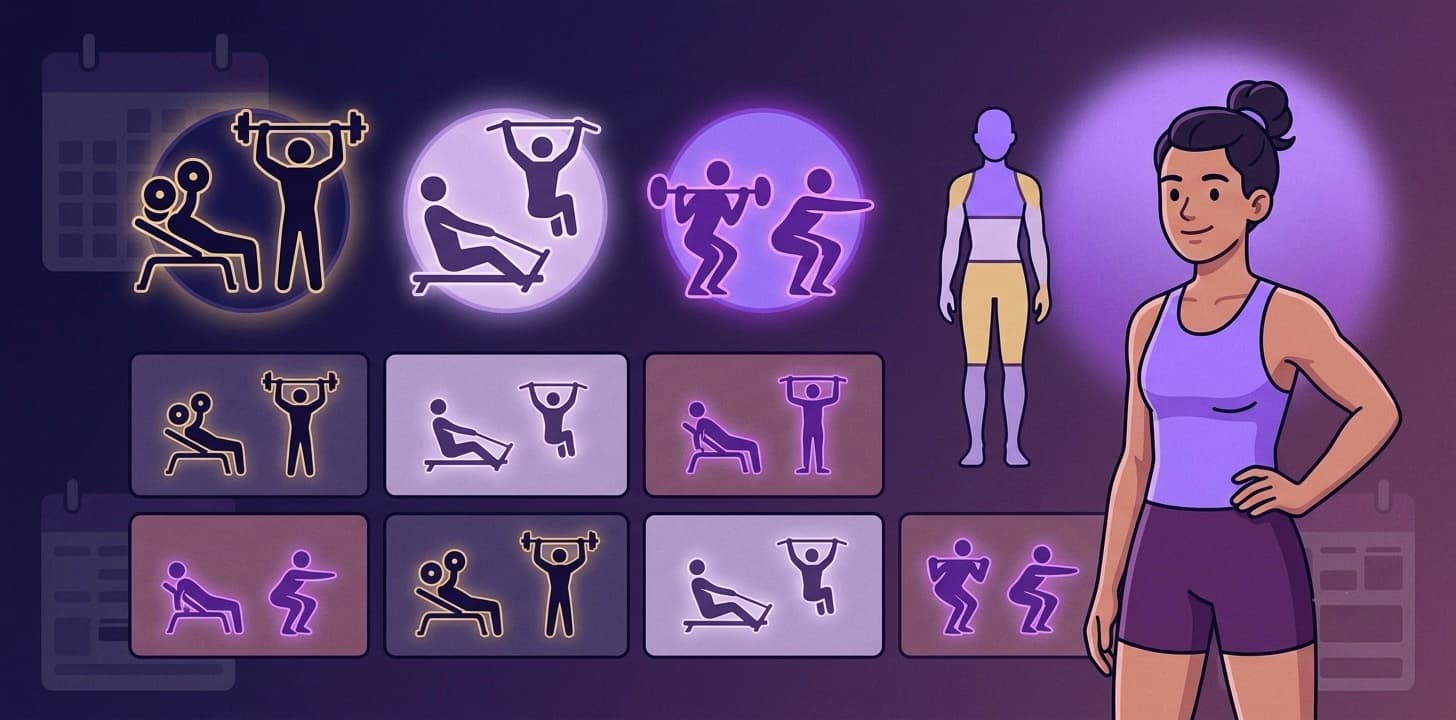
For a push/pull/legs split, these three protocols cover every training day. If you run an upper/lower or other split, combine elements from the relevant protocols above.
Static Stretching: Save It for After
This is one of the most persistent misconceptions in fitness. Static stretching before lifting — holding a hamstring stretch for 30 seconds, pulling your arm across your chest — has been shown to reduce force production by 5-8% and decrease power output by up to 3%. A meta-analysis of 104 studies in the European Journal of Applied Physiology concluded that static stretching lasting over 45 seconds per muscle group acutely impairs strength, power, and explosive performance.
The mechanism is straightforward. Static stretching temporarily reduces the stiffness of the musculotendinous unit. Some stiffness is good before lifting — it is what allows your muscles and tendons to store and release elastic energy during the stretch-shortening cycle. Reduce that stiffness and you lose power.
Static stretching has real value for improving long-term flexibility and reducing post-exercise muscle soreness. It belongs in your cooldown, not your warm-up. Save it for after the last set, when performance no longer matters and your muscles are warm and pliable.
The Cost of Skipping
The short-term cost of skipping a warm-up is a 5-10% reduction in performance. That translates to fewer reps at a given weight, less total volume, and a weaker progressive overload signal. Over weeks and months, those lost reps compound into meaningful lost gains.
The long-term cost is injury. Cold muscles, unstimulated joints, and unprimed nervous systems are more vulnerable to strains, sprains, and acute injuries. A pulled hamstring does not just hurt for a week — it disrupts training for 4-8 weeks. A shoulder impingement can nag for months. These are not freak accidents. They are predictable outcomes of asking cold tissue to handle loads it was not prepared for.
Eight to twelve minutes. That is the investment. The return is better performance today and fewer injuries across your entire training career. There is no shortcut in the gym that offers a better ratio of time spent to results gained.