The 10 Best Compound Exercises (And How to Do Them)
12 min read · April 2025 · by Manikanta Sirumalla
The 10 Best Compound Exercises (And How to Do Them)
Compound exercises are movements that work multiple joints and muscle groups simultaneously. A squat bends at the ankle, knee, and hip. A bench press moves at the shoulder and elbow. Compare that to a bicep curl — single joint, single muscle group, limited loading potential.
Compound movements are the foundation of effective strength training for three reasons:
- Higher loading potential. You can squat 300 lbs but you cannot leg extend 300 lbs. Greater loads mean greater mechanical tension, which is the primary driver of muscle growth.
- More muscle per minute. A barbell row trains your lats, rhomboids, rear delts, biceps, and erectors in one movement. Isolating each would take five separate exercises.
- Functional carryover. Compound movements mimic real-world patterns — pushing, pulling, hinging, squatting, and carrying.
If you build your program around these 10 exercises and apply progressive overload consistently, you will build more muscle and strength than any amount of isolation work alone.
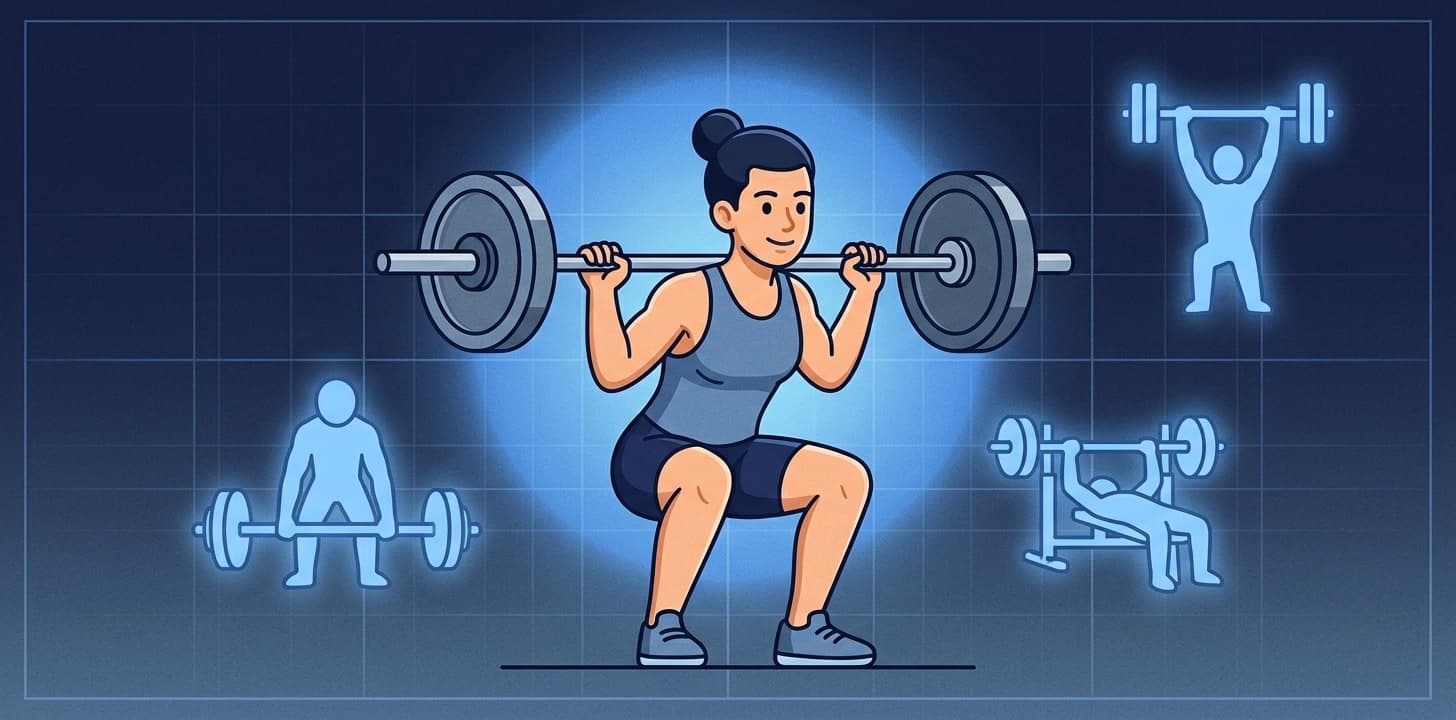
1. Barbell Back Squat
Muscles worked: Quadriceps (primary), glutes, adductors, hamstrings, erector spinae, core
The squat is the single most productive lower-body exercise. It loads the entire posterior and anterior chain through a full range of motion, and it has the highest loading potential of any leg movement.
Form cues:
- Feet shoulder-width apart, toes turned out 15-30 degrees
- Brace your core hard — take a deep breath into your belly, not your chest, and push your abs out against an imaginary belt
- Break at the hips and knees simultaneously, sitting down and back
- Descend until your hip crease drops below your knee (parallel or below)
- Drive through the full foot — not just the heels — and stand tall
Common mistakes:
- Knees caving inward (valgus collapse). Fix: actively push knees out over your toes throughout the movement.
- Rising hips faster than shoulders out of the hole (the "good morning squat"). Fix: keep your chest up and think about pushing your back into the bar.
Variations: Front squat (shifts emphasis to quads and demands more upright torso), goblet squat (beginner-friendly with a dumbbell or kettlebell), safety bar squat (easier on shoulders).
2. Conventional Deadlift
Muscles worked: Glutes, hamstrings, erector spinae (primary), quadriceps, lats, traps, forearms
The deadlift is the purest test of full-body strength. You pick a heavy thing up off the floor. Every muscle from your hands to your feet contributes.
Form cues:
- Stand with feet hip-width apart, bar over mid-foot (about 1 inch from your shins)
- Hinge at the hips and grip the bar just outside your knees
- Pull your chest up to create a flat or slightly arched back — your spine should be neutral, not rounded
- Push the floor away with your legs while pulling your shoulders back simultaneously
- Lock out by squeezing your glutes at the top — do not hyperextend your lower back
Common mistakes:
- Rounding the lower back under load. Fix: set your back before you pull — film yourself from the side and check.
- Jerking the bar off the floor. Fix: take the slack out of the bar first by pulling gently until you feel tension, then drive.
Variations: Sumo deadlift (wider stance, more quad and adductor involvement), trap bar deadlift (easier to learn, less spinal loading), deficit deadlift (standing on a 1-2 inch platform for extended range of motion).
3. Barbell Bench Press
Muscles worked: Pectoralis major (primary), anterior deltoids, triceps
The bench press is the standard upper-body pressing movement and the lift most people are familiar with. It builds the chest, shoulders, and triceps in a single movement.
Form cues:
- Retract your shoulder blades and pin them into the bench — imagine squeezing a pencil between them
- Slight arch in your lower back (feet flat on the floor or pulled back under you for leg drive)
- Grip the bar so your forearms are vertical at the bottom of the movement — typically 1.5x shoulder width
- Lower the bar to your lower chest/upper abdomen, not your neck
- Press in a slight arc, finishing with the bar over your shoulders
Common mistakes:
- Flaring elbows to 90 degrees (stresses the shoulder joint). Fix: tuck elbows to roughly 45-75 degrees from your torso.
- Bouncing the bar off your chest. Fix: touch your chest with control, pause for a beat, then press.
Variations: Incline bench press (30-45 degree angle, emphasizes upper chest and front delts), dumbbell bench press (greater range of motion, unilateral strength balance), close-grip bench press (emphasizes triceps).
4. Overhead Press (Standing Barbell Press)
Muscles worked: Anterior and lateral deltoids (primary), triceps, upper chest, serratus anterior, core
The overhead press is the most honest upper-body strength test. There is no bench to support you — your core and stabilizers must work to keep you upright under load.
Form cues:
- Start with the bar in the front rack position, resting on your anterior deltoids, hands just outside shoulder width
- Brace your core and squeeze your glutes to create a stable base
- Press the bar straight up — move your head back slightly as the bar passes your face, then push your head through once the bar clears
- Lock out with the bar directly over your mid-foot, arms fully extended
Common mistakes:
- Excessive lower back arch (using your spine as a lever instead of your shoulders). Fix: squeeze your glutes hard throughout the press. If you still arch, the weight is too heavy.
- Pressing the bar forward in an arc instead of straight up. Fix: the bar path should be as vertical as possible. Film from the side.
Variations: Seated overhead press (removes the stability demand, allows heavier loading), dumbbell overhead press (greater range of motion and unilateral work), push press (uses leg drive — a good overload tool).
5. Barbell Bent-Over Row
Muscles worked: Latissimus dorsi, rhomboids, rear deltoids (primary), biceps, erector spinae, lower traps
The barbell row is the horizontal pulling counterpart to the bench press. A balanced program needs roughly equal volumes of horizontal pushing and pulling to maintain shoulder health and postural balance.
Form cues:
- Hinge forward to roughly 45-60 degrees, maintaining a neutral spine (similar to the top position of a Romanian deadlift)
- Grip the bar slightly wider than shoulder width
- Pull the bar to your lower chest or upper abdomen — not to your belly button
- Squeeze your shoulder blades together at the top for a one-count before lowering
Common mistakes:
- Using too much body english (jerking the torso upright to swing the weight up). Fix: if you cannot row it without excessive torso movement, lower the weight.
- Letting the lower back round. Fix: maintain the hinge angle throughout the set — your torso should stay relatively still.
Variations: Pendlay row (bar starts on the floor each rep, more explosive), one-arm dumbbell row (unilateral, easier on the lower back), T-bar row (slightly different angle, often more comfortable).
6. Pull-Up
Muscles worked: Latissimus dorsi (primary), biceps, lower traps, rhomboids, forearms, core
The pull-up is the king of vertical pulling movements. It is also one of the best bodyweight exercises in existence for building upper-body strength and size.
Form cues:
- Grip the bar slightly wider than shoulder width, palms facing away (pronated grip)
- Start from a dead hang — arms fully extended, no kipping
- Initiate the pull by depressing your shoulder blades (pulling them down and back)
- Pull until your chin clears the bar, then lower with control to full extension
Common mistakes:
- Half reps (not going to full extension at the bottom). Fix: every rep starts from a dead hang.
- Kipping or swinging. Fix: cross your ankles behind you and brace your core to eliminate momentum.
Variations: Chin-up (palms facing you, more bicep emphasis), neutral grip pull-up (palms facing each other, easiest on the shoulders), weighted pull-up (add a belt and plates once bodyweight pull-ups exceed 10-12 clean reps).
7. Dip
Muscles worked: Pectoralis major (lower fibers), triceps (primary), anterior deltoids
Dips are the upper-body squat — a heavy compound movement that loads the chest and triceps through a long range of motion. They are also one of the most scalable exercises: beginners use band assistance, intermediates use bodyweight, advanced lifters add 45+ lbs.
Form cues:
- Grip the parallel bars and support yourself with locked arms
- Lean forward slightly (15-20 degrees) to shift emphasis to the chest — staying completely upright makes it a tricep-dominant movement
- Lower until your upper arms are at least parallel to the floor (roughly a 90-degree elbow bend)
- Press back up to lockout
Common mistakes:
- Going too deep too soon (excessive shoulder extension stresses the joint). Fix: build depth gradually — start at 90 degrees and progress deeper over weeks as mobility allows.
- Flaring elbows excessively wide. Fix: keep elbows at roughly 45 degrees from your torso, similar to the bench press.
Variations: Ring dips (unstable surface demands more stabilizer activation), bench dips (easier regression for beginners), weighted dips (add a belt and chain once bodyweight exceeds 12-15 clean reps).
8. Walking Lunge
Muscles worked: Quadriceps, glutes (primary), hamstrings, adductors, calves, core
Lunges train the legs unilaterally — one leg at a time — which exposes and corrects strength imbalances that bilateral movements like squats can mask. The walking variation adds a dynamic component and demands more coordination.
Form cues:
- Step forward with a stride long enough that both knees form approximately 90-degree angles at the bottom
- Keep your torso upright — avoid leaning forward excessively
- Lower your back knee toward the floor without slamming it
- Drive through the front foot to step forward into the next rep
Common mistakes:
- Front knee drifting excessively past the toes (this is fine within reason, but extreme forward knee travel increases patellar tendon stress). Fix: take a slightly longer stride.
- Narrow stance (feet too close together laterally, causing balance issues). Fix: imagine walking on railroad tracks, not a tightrope.
Variations: Reverse lunge (stepping backward — easier on the knees), Bulgarian split squat (rear foot elevated, greater range of motion and intensity), dumbbell or barbell loaded lunges.
9. Hip Thrust
Muscles worked: Glutes (primary), hamstrings, core
The hip thrust is the most effective glute-specific compound movement. Research by Bret Contreras and colleagues has consistently shown that hip thrusts produce higher glute EMG activation than squats or deadlifts, making them essential for anyone prioritizing glute development.
Form cues:
- Sit on the floor with your upper back against a bench, knees bent, feet flat on the floor about shoulder-width apart
- Roll a loaded barbell over your legs until it sits in your hip crease (use a pad)
- Drive through your heels and squeeze your glutes to lift your hips until your torso is parallel to the floor
- Pause at the top with a hard glute squeeze, then lower with control
Common mistakes:
- Hyperextending the lower back at the top (arching past neutral). Fix: think about tucking your ribcage down toward your pelvis as you reach the top. You should feel your glutes, not your lower back.
- Pushing through the toes instead of the heels. Fix: you should be able to wiggle your toes at the top of the movement.
Variations: Single-leg hip thrust (unilateral, bodyweight or lightly loaded), glute bridge (performed from the floor instead of a bench — a good starting point), banded hip thrust (add a resistance band above the knees for extra abductor activation).
10. Romanian Deadlift (RDL)
Muscles worked: Hamstrings, glutes (primary), erector spinae, lats, forearms
The RDL is the best hamstring-dominant hip hinge. Unlike the conventional deadlift, which starts from the floor and trains the entire posterior chain, the RDL focuses on the eccentric stretch of the hamstrings and the hip-hinge pattern.
Form cues:
- Start standing with the bar at hip height (unrack from hooks or deadlift it up)
- Push your hips back while maintaining a slight knee bend (15-20 degrees) — your knees should not bend further during the movement
- Lower the bar by hinging at the hips, keeping the bar close to your body (it should graze your thighs)
- Descend until you feel a strong hamstring stretch — typically when the bar reaches mid-shin to just below the knees
- Drive your hips forward to return to standing, squeezing your glutes at the top
Common mistakes:
- Bending the knees too much (turning it into a conventional deadlift). Fix: the RDL is a hip hinge, not a squat. Lock in a slight knee bend and keep it constant.
- Letting the bar drift away from your body. Fix: imagine painting your legs with the bar on the way down. If the bar moves forward, your lower back takes the load instead of your hamstrings.
Variations: Single-leg RDL (unilateral, excellent for balance and hamstring development), dumbbell RDL (easier to learn, lower barrier to entry), snatch-grip RDL (wider grip increases upper back demand).
Programming the Big 10
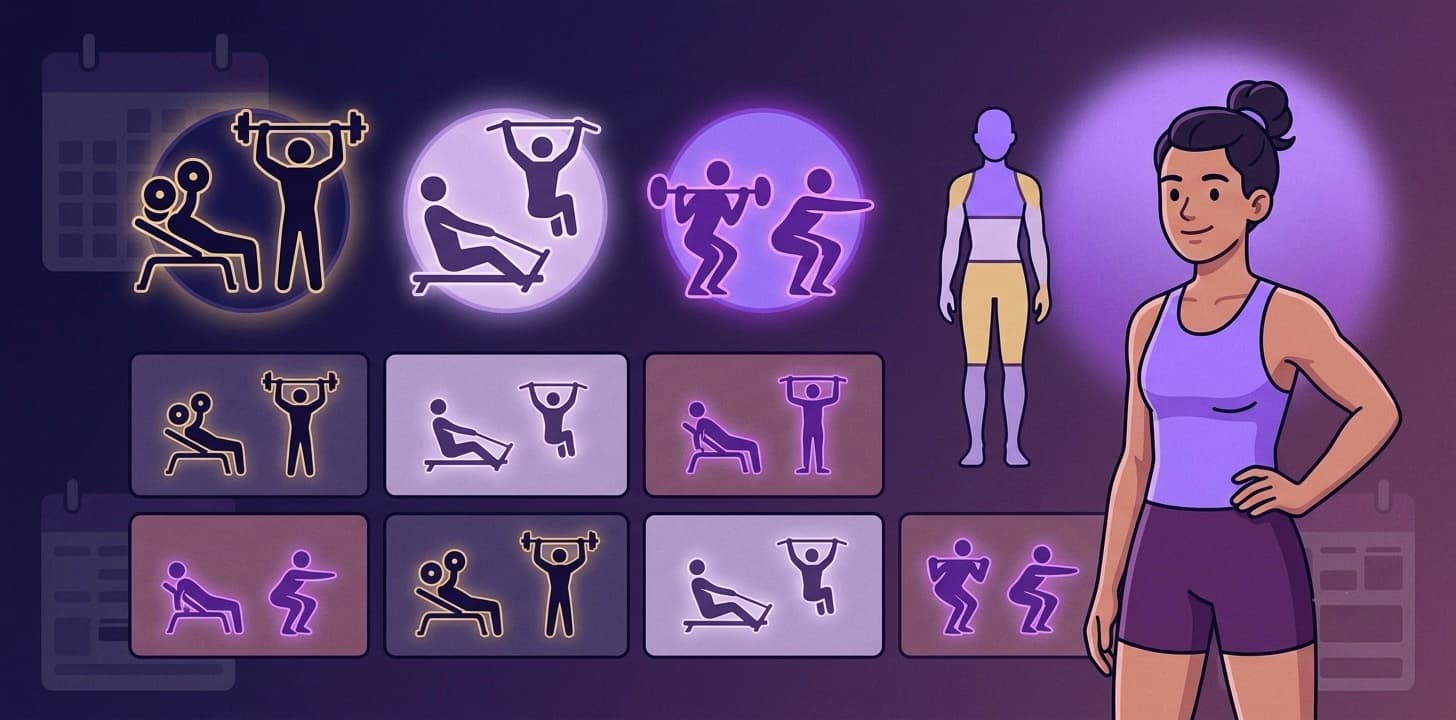
You do not need to do all 10 exercises in every session. A productive full-body workout might include 3-4 of these movements. A well-designed split distributes them across the week so each movement pattern is trained 2-3 times.
Here is a sample weekly distribution:
| Day | Compound Exercises | Sets |
|---|---|---|
| Push A | Bench Press, Overhead Press, Dip | 4/3/3 |
| Pull A | Barbell Row, Pull-Up, Romanian Deadlift | 4/3/3 |
| Legs A | Squat, Walking Lunge, Hip Thrust | 4/3/3 |
| Push B | Incline Bench, Overhead Press, Close-Grip Bench | 4/3/3 |
| Pull B | Pull-Up, One-Arm Row, Conventional Deadlift | 3/3/4 |
| Legs B | Front Squat, Bulgarian Split Squat, Hip Thrust | 4/3/3 |
This hits each movement pattern twice per week with enough variety to prevent staleness while maintaining the consistency needed for progressive overload.
A Note on Isolation Work
Compound exercises should be the foundation, not the entirety, of your program. Isolation exercises (curls, lateral raises, leg extensions, face pulls) still have value — they address lagging muscle groups, accumulate volume without systemic fatigue, and target muscles that compounds underserve (like the lateral deltoid and calves).
The rule of thumb: build your session around 2-4 compound movements, then add 2-3 isolation exercises to address specific needs. Compounds first, isolations after. That order matters because compound lifts demand the most energy and coordination — you want to be fresh for them.
If you are unsure which supersets or exercise pairings work best with these movements, that is worth exploring as you become more advanced. For now, master the 10 movements above, track your progress, and let the data guide your adjustments.