Isometric Training: Building Strength Without Moving
8 min read · May 2025 · by Manikanta Sirumalla
Isometric Training: Building Strength Without Moving
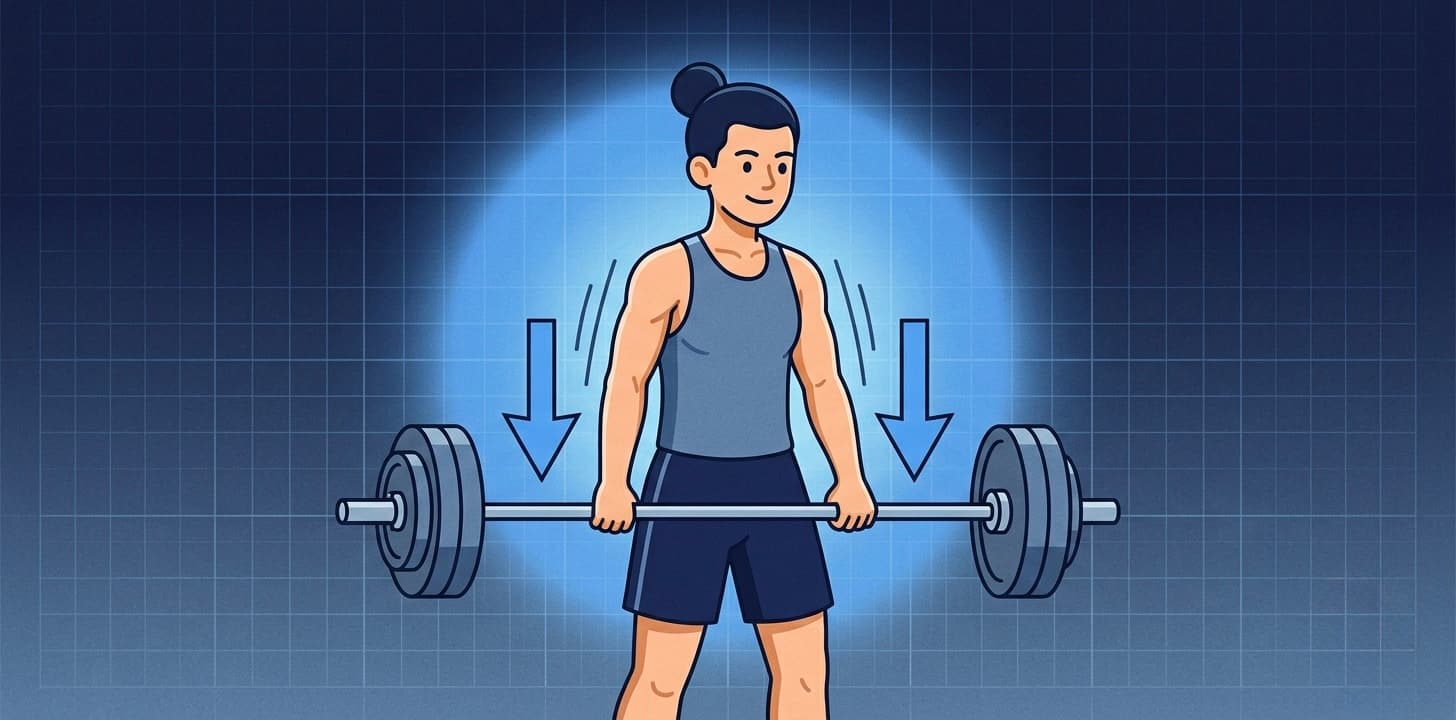
An isometric contraction occurs when a muscle produces force without changing length. You push against an immovable object, or you hold a movable load at a fixed position. The joint angle does not change. No repetition occurs. And yet, this seemingly simple form of training produces measurable strength gains, reduces pain in injured tendons, and develops positional stability that transfers directly to dynamic movements.
Isometric training was popularized in the 1950s and 1960s by researchers Hettinger and Muller, who demonstrated that a single 6-second isometric contraction at two-thirds maximal effort, performed once daily, produced significant strength gains over 10 weeks. Their findings surprised the scientific community, and while subsequent research refined the protocols, the core finding has been replicated consistently: isometrics build real, measurable strength.
Two Types of Isometric Contraction
Not all isometrics are equal. The two subtypes produce different physiological responses and serve different purposes.
Yielding Isometrics (Holding Against Load)
In a yielding isometric, you hold a load at a fixed position, resisting gravity or an external force that would otherwise move the joint. Examples:
- Wall sit: Holding the bottom of a squat position with your back against a wall
- Dead hang: Hanging from a pull-up bar with straight arms
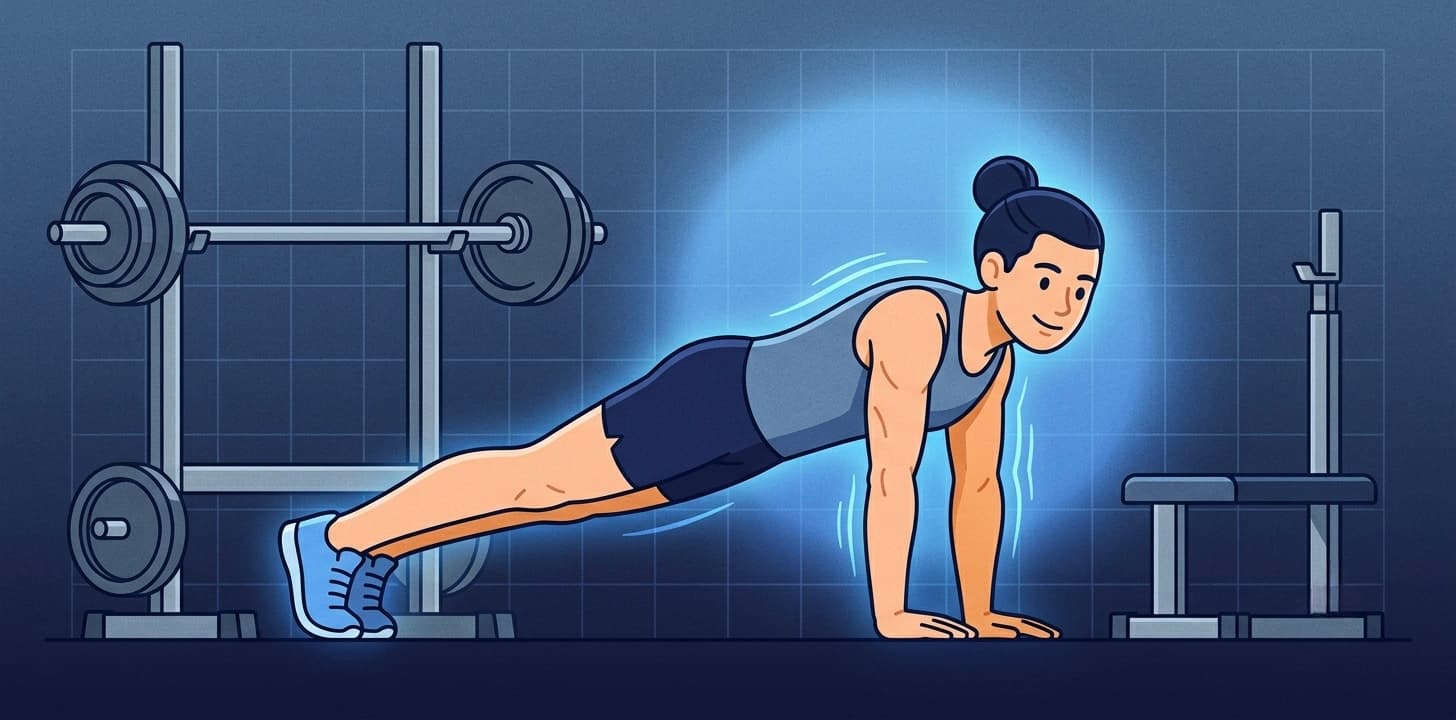
- Plank: Holding a rigid push-up position on your forearms
- Pause squat hold: Holding the bottom position of a squat with a barbell on your back
- Farmer's carry (static): Holding heavy dumbbells or a trap bar at your sides without walking
Yielding isometrics primarily train muscular endurance at the specific joint angle, develop connective tissue resilience, and build work capacity. The intensity is submaximal by nature: you are holding a load you could move if you chose to, and the challenge comes from sustaining the hold over time (typically 10-60 seconds).
Overcoming Isometrics (Pushing Against Immovable Object)
In an overcoming isometric, you push or pull against an immovable resistance with maximal or near-maximal effort. The load cannot move regardless of how much force you apply. Examples:
- Pushing against the pins in a power rack at a specific squat or bench press height
- Pulling a barbell that is chained to the floor at a specific deadlift height
- Pushing against a wall as hard as possible in a pressing motion
- Isometric mid-thigh pull (a common assessment tool in sports science)
Overcoming isometrics produce the highest force outputs of any contraction type, even higher than eccentric contractions. Babault et al. (2001) showed that maximal isometric force exceeds concentric maximum by approximately 10-15%. This makes overcoming isometrics a potent stimulus for neural adaptations: maximal motor unit recruitment, improved rate of force development, and enhanced intermuscular coordination.
The key distinction: yielding isometrics challenge your ability to sustain force over time. Overcoming isometrics challenge your ability to produce maximum force instantaneously.
Joint Angle Specificity: The Critical Limitation
The most important thing to understand about isometric training is that strength gains are highly specific to the joint angle trained. This is both a feature and a limitation.
Research by Kitai and Sale (1989) and Thépaut-Mathieu et al. (1988) demonstrated that isometric training at a specific joint angle produces strength gains that are maximal at that angle and diminish by approximately 50% at angles 20-30 degrees away. In practical terms, if you perform wall sits at 90 degrees of knee flexion, you will get significantly stronger at 90 degrees but only modestly stronger at 60 or 120 degrees.
This specificity has two practical implications:
-
You must train at multiple angles to build strength across the full range of motion. Three angles (one at the stretched position, one at mid-range, and one at the shortened position) provide reasonable coverage for most exercises.
-
You can target weak points precisely. If your squat always fails at the same depth, performing isometric holds at exactly that sticking point angle builds strength where you need it most. This is one of the most valuable applications of isometrics for experienced lifters.
Practical Applications
For Strength Plateaus
When a lift stalls, the bottleneck is often at a specific joint angle: the "sticking point." Isometric training at or near the sticking point addresses this weakness directly. Common sticking points and their isometric interventions:
| Lift | Common Sticking Point | Isometric Protocol |
|---|---|---|
| Squat | Bottom of the hole (parallel) | Pause squat holds at parallel, 3x10 sec |
| Bench Press | 2-3 inches off the chest | Pin press isometric at that height, 5x5 sec max effort |
| Deadlift | Just below the knees | Isometric pull against pins at knee height, 5x5 sec max effort |
| Overhead Press | Forehead height | Pin press isometric at forehead height, 5x5 sec max effort |
For Rehabilitation and Pain Management
Isometric exercise has a unique analgesic (pain-reducing) effect on tendons. Rio et al. (2015) demonstrated that isometric quadriceps contractions (5x45 seconds at 70% of maximal voluntary contraction) produced immediate and lasting pain reduction in athletes with patellar tendinopathy: greater pain reduction than isotonic (dynamic) exercise.
The mechanism is likely a combination of cortical inhibition of pain signaling and tendon loading without the aggravating shear forces that occur during dynamic movement. For this reason, isometrics are the first exercise modality introduced in many tendon rehabilitation protocols:
Phase 1 (Acute/Reactive): Isometric holds at pain-free angles, 4-5 sets of 30-45 seconds, daily Phase 2 (Subacute): Progress to isometrics at angles that were previously painful, increase load Phase 3 (Remodeling): Transition to slow eccentric exercises, then full dynamic training
Common isometric rehab applications:
- Patellar tendinopathy: Spanish squat holds (wall-assisted squat with band behind knees), 4x45 sec
- Lateral epicondylitis: Isometric wrist extension with fist closed, 5x30 sec
- Rotator cuff irritation: Isometric external rotation with arm at side, 4x20 sec
- Achilles tendinopathy: Single-leg isometric calf raise hold, 4x45 sec
For Core Stability
The core muscles (transverse abdominis, internal and external obliques, erector spinae, multifidus) function primarily as stabilizers during compound lifts. Their job is to resist movement (anti-extension, anti-rotation, anti-lateral flexion), not to produce it. This makes isometric training the most specific form of core training for strength athletes.
Effective isometric core exercises:
| Exercise | Primary Function | Duration |
|---|---|---|
| Front plank | Anti-extension | 3x30-60 sec |
| Side plank | Anti-lateral flexion | 3x30-45 sec per side |
| Pallof press hold | Anti-rotation | 3x20-30 sec per side |
| Dead bug (with hold) | Anti-extension under movement | 5x10 sec per side |
| Loaded carry (static hold) | Total trunk stability | 3x30-45 sec |
For experienced lifters who can hold a front plank for over 60 seconds easily, the exercise is no longer challenging. Progress by adding load (plate on back), reducing base of support (elevate feet), or transitioning to more demanding variations (long-lever plank, body saw).
For Grip Strength
Grip strength is almost entirely isometric in practice: you hold an object and resist it slipping from your fingers. The best grip exercises reflect this:
- Dead hangs: 3x maximum duration, 2-3x per week. Progress from two-arm to one-arm.
- Farmer's holds: Heavy dumbbells or trap bar, 3x30-45 seconds. Use loads that challenge you by 30 seconds.
- Fat grip holds: Attach Fat Gripz or use a thick bar to increase diameter. 3x20-30 seconds.
- Plate pinches: Pinch two smooth plates together (10 lb + 10 lb), hold for 3x20-30 seconds.
Programming Isometric Training
As a Supplement to Dynamic Training
Isometrics are most effective as a supplement to, not a replacement for, dynamic (concentric/eccentric) training. Use them to address specific weaknesses, rehab injuries, or develop positions that need reinforcement.
Yielding isometrics (endurance/position):
- 3-5 sets of 20-60 seconds
- Intensity: 50-80% of maximum
- Frequency: 3-5x per week
- Recovery demand: Low, can be done daily
Overcoming isometrics (maximal strength):
- 3-6 sets of 3-8 seconds per effort
- Intensity: 90-100% maximum effort
- Rest: 2-3 minutes between sets
- Frequency: 2-3x per week per joint angle
- Recovery demand: Moderate to high (CNS fatigue)
Integration Into a Training Session
Warm-up: Use yielding isometrics (5-10 second holds at key positions) to activate target muscles and rehearse positions. A 10-second pause squat at the bottom with an empty bar primes the quads, glutes, and core for heavy squatting.
Accessory work: Insert overcoming isometrics at sticking point angles after your main working sets. 3-5 sets of 5-second max-effort pushes against pins in a rack.
Finisher: Yielding isometric holds to failure as the last exercise for a muscle group. A single set of wall sit to failure, or a dead hang to failure, is a simple and effective way to create additional metabolic stress without adding more dynamic volume.
Common Mistakes
Holding your breath. Isometric contractions, especially at high effort, create a strong urge to hold your breath (Valsalva maneuver). For maximal overcoming isometrics, a brief Valsalva is acceptable and may be necessary. For longer yielding holds (30-60 seconds), you must breathe: holding your breath will spike blood pressure dangerously. Practice breathing rhythmically during holds.
Training only one angle. Due to joint angle specificity, training isometrics only at one position leaves the rest of the range undeveloped. If you use isometrics as a primary strength tool (not just a supplement), train at minimum 3 joint angles per movement.
Neglecting progressive overload. Isometric training still requires progression. If you held a wall sit for 45 seconds last week, aim for 50 seconds this week, or add a weight vest. If you pushed against pins for 5 seconds, try to produce more force next time (use a force plate if available) or extend to 6-7 seconds.
Using isometrics as your only training. Isometrics build strength at specific angles but do not develop the full-range-of-motion strength, coordination, and muscle lengthening that dynamic training provides. Use isometrics to supplement a program built on compound and isolation movements, not to replace it.