Time Under Tension: What the Research Actually Says
8 min read · May 2025 · by Manikanta Sirumalla

Time Under Tension: What the Research Actually Says
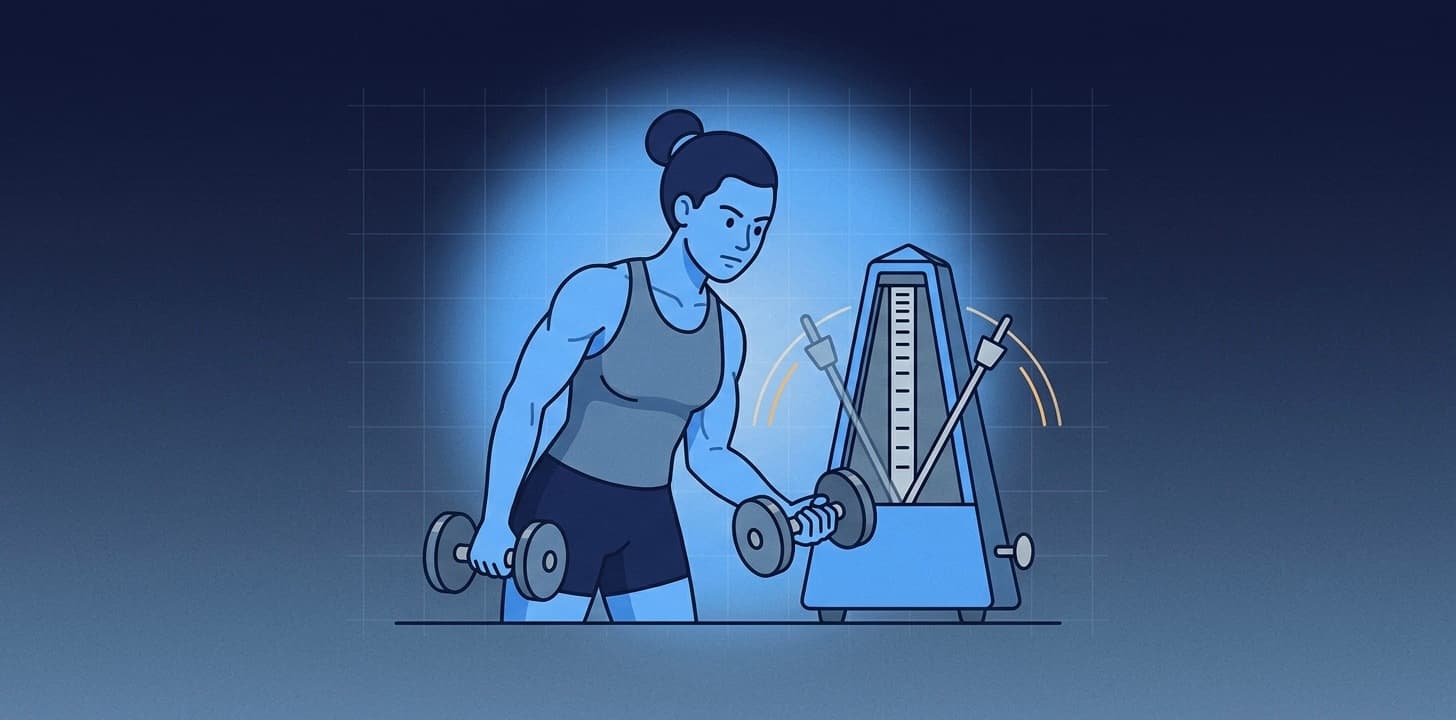
Time under tension, the total duration a muscle spends under load during a set, became a mainstream fitness concept in the 1990s after Charles Poliquin and Ian King popularized it in their training programs. The idea was compelling: longer TUT equals more growth stimulus. Slow your reps down, spend more time contracting, grow more muscle. It sounded logical and gave lifters a concrete variable to manipulate beyond just weight and reps.
Three decades of research later, the picture is more complicated. TUT matters, but not in the way most people think, and not as much as other variables that get less attention.
Defining Time Under Tension
TUT is the total time a muscle spends producing force during a set. It is calculated by multiplying the number of reps by the time per rep (which depends on tempo).
Example calculations:
| Set Parameters | Tempo | Time Per Rep | Total TUT |
|---|---|---|---|
| 10 reps | 1-0-1-0 (fast) | 2 sec | 20 sec |
| 10 reps | 3-0-1-0 (slow eccentric) | 4 sec | 40 sec |
| 10 reps | 4-1-2-0 (slow with pause) | 7 sec | 70 sec |
| 6 reps | 3-1-2-0 (moderate) | 6 sec | 36 sec |
| 20 reps | 1-0-1-0 (fast, high rep) | 2 sec | 40 sec |
Notice that 10 reps with a 3-0-1-0 tempo produces the same TUT as 20 reps at a fast tempo (40 seconds). But these two scenarios produce very different training stimuli: different loads, different levels of mechanical tension, different metabolic responses. This is the first clue that TUT alone does not determine the training effect.
The Original TUT Hypothesis
The TUT hypothesis proposed that there were optimal TUT ranges for different goals:
- Strength: 1-20 seconds per set
- Hypertrophy: 40-70 seconds per set
- Muscular endurance: 70-120+ seconds per set
Under this framework, a set that lasted 40-70 seconds, regardless of how you achieved that duration, was considered optimal for muscle growth. This led to widespread adoption of super-slow training methods (8-10 second eccentrics, 4-5 second concentrics) that prioritized TUT above all else.
The problem? The research does not support TUT as an independent driver of hypertrophy once other variables are controlled.
What the Research Actually Shows
TUT vs. Load: Load Wins
Schoenfeld, Ogborn, and Krieger (2015) conducted a meta-analysis examining the effects of repetition duration on muscular hypertrophy. Their key findings:
- Rep durations of 0.5-8 seconds (total time for one rep) produced similar hypertrophy when sets were taken to or near failure.
- Extremely slow reps (over 10 seconds total) produced less hypertrophy than moderate-speed reps. The reason: super-slow training requires such a dramatic reduction in load (typically 40-60% less than normal working weight) that the mechanical tension per fiber drops below the optimal threshold for growth, even though TUT is very high.
- The authors concluded that load and proximity to failure matter more than TUT for hypertrophy.
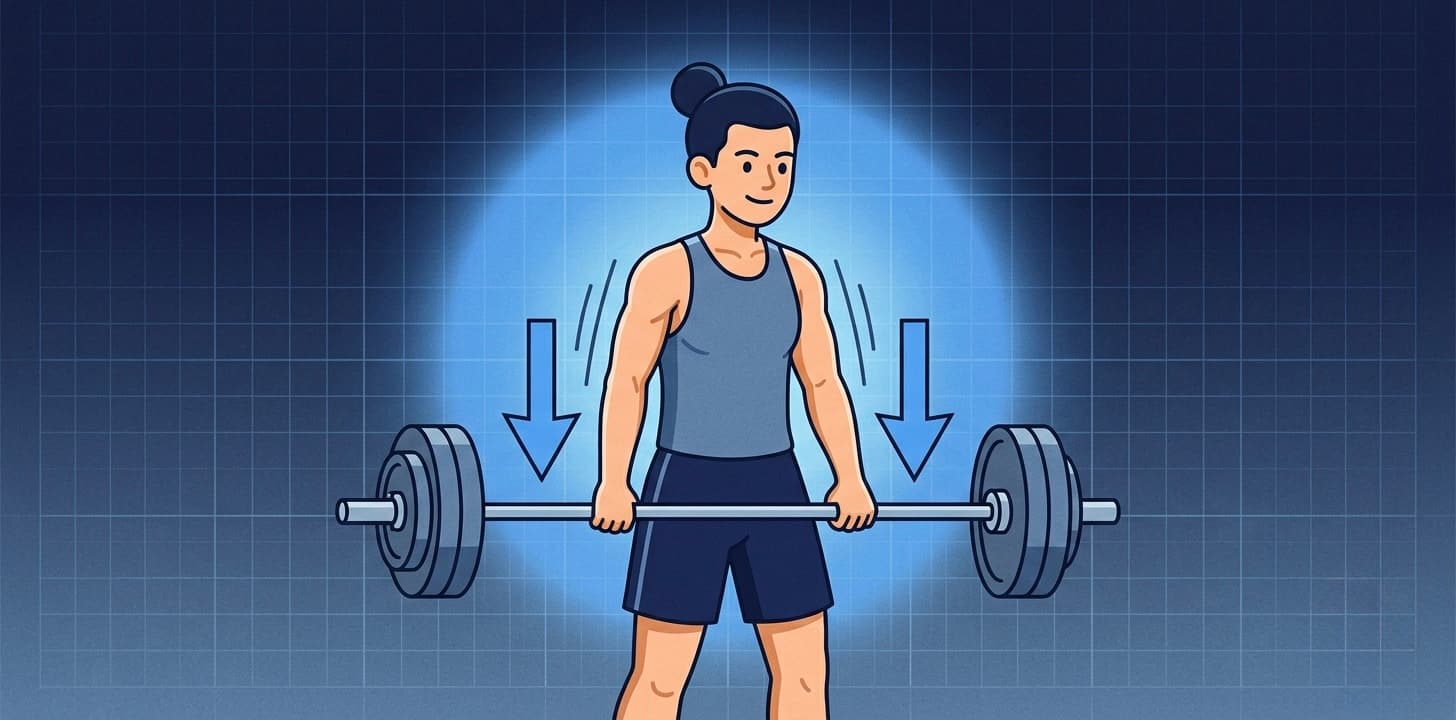
This is a critical finding. If you slow your reps to achieve longer TUT but must drop the weight by 40% to do so, you have sacrificed mechanical tension, the primary growth driver, for metabolic stress. For most trainees, that trade-off produces inferior results.
Volume vs. TUT: Volume Wins
When total weekly volume (sets x reps x load) is equated, manipulating TUT through tempo changes does not produce additional hypertrophy. Burd et al. (2012) found that performing sets to failure with 30% of 1RM (very high TUT, low load) produced similar muscle protein synthesis rates as sets to failure with 90% of 1RM (low TUT, high load). But the critical variable was not TUT: it was training to failure. Both conditions recruited the full spectrum of motor units because both went to failure.
This suggests that the original TUT hypothesis confused the variable that mattered. What makes a set productive is not how long it takes, but whether sufficient mechanical tension is applied to enough motor units. Sets taken to or near failure achieve this regardless of TUT.
Mechanical Tension Is the Key
Brad Schoenfeld's tension-volume model (2010, updated 2021) identifies mechanical tension as the primary mechanism driving muscle protein synthesis. TUT is relevant only insofar as it affects total mechanical tension:
- Longer TUT at the same load = more total tension (beneficial, up to a point)
- Longer TUT at a lower load = tension per fiber drops (potentially detrimental)
- Same TUT from more reps at a lighter weight vs. fewer reps at a heavier weight = different tension profiles that are not equivalent
The practical takeaway: do not treat TUT as an independent variable. Treat it as a secondary outcome of your rep count, load, and tempo choices.
When TUT Manipulation Is Actually Useful
Despite TUT not being the independent growth driver it was once believed to be, there are genuine scenarios where deliberately increasing TUT produces better outcomes.
1. Isolation Exercises for Lagging Muscle Groups
For exercises like lateral raises, bicep curls, leg extensions, and cable flyes, slowing the tempo to 3-4 seconds eccentric and 2 seconds concentric with a 1-second squeeze keeps the target muscle under load for longer and prevents momentum from stealing the stimulus. A set of 12 cable lateral raises at a 3-1-2-0 tempo (72 seconds TUT) produces a qualitatively different stimulus than 12 ballistic swings that take 20 seconds.
In isolation exercises where the load is inherently low and mechanical tension per fiber is modest, extending TUT through slower tempos genuinely increases the total tension stimulus on the target muscle.
2. Metabolic Stress Training
During intentional metabolic stress blocks, where the goal is cell swelling, metabolite accumulation, and satellite cell activation, longer TUT is the mechanism through which metabolic stress is achieved. Blood flow restriction (BFR) training, drop sets, and extended sets all work partly by maintaining TUT beyond normal thresholds.
Research by Goto et al. (2005) showed that adding a single high-rep, slow-tempo "metabolic" set after heavy training produced greater hormonal response and modestly improved hypertrophy compared to heavy training alone.
3. Technique Development
Slow tempos, and therefore longer TUT, force positional awareness throughout the full range of motion. For beginners learning a new movement pattern, or intermediate lifters correcting a technical flaw, deliberately extending TUT through slow eccentrics and isometric pauses is one of the most effective coaching tools available.
4. Rehabilitation and Return to Training
During injury rehabilitation, external load is often limited. Extending TUT at lighter loads provides a meaningful training stimulus while keeping absolute forces on healing tissues within safe limits. A 5-second eccentric squat at 95 lbs provides more productive stimulus for a rehabbing knee than a fast squat at the same weight.
5. Training With Limited Equipment
If you only have access to light dumbbells or resistance bands (home gym, hotel gym, travel), slowing the tempo and extending TUT is the primary tool for making lighter loads challenging enough to produce an adaptive stimulus. A set of push-ups at 4-2-2-0 tempo (8 seconds per rep x 10 reps = 80 seconds TUT) provides a dramatically superior stimulus compared to fast push-ups that are over in 20 seconds.
The TUT-Volume Interaction
There is one more nuance worth understanding. TUT per set and total volume (sets x reps) interact in an important way: extremely high TUT per set increases fatigue disproportionately, reducing the total number of productive sets you can perform in a session.
If you perform all your bench press sets at a 5-1-3-0 tempo (9 seconds per rep, ~72 seconds TUT for 8 reps), you will be significantly more fatigued after 3 sets than if you used a 2-0-1-0 tempo (3 seconds per rep, ~24 seconds TUT for 8 reps). The slow-tempo approach may produce more stimulus per set, but you may only be able to perform 3 productive sets instead of 5. The net result, total volume x total tension, may actually favor the faster tempo because it allows more total sets.
This is why the extreme slow-training protocols (Super Slow, Power of 10) ultimately fell out of favor despite their theoretical appeal. They maximized TUT per set at the expense of total productive volume per session and per week.
Practical TUT Recommendations
Based on the totality of the evidence:
| Goal | Recommended Rep Duration | TUT Per Set | Notes |
|---|---|---|---|
| General hypertrophy | 3-6 sec per rep | 30-60 sec | 2-3 sec eccentric minimum |
| Strength | 2-4 sec per rep | 10-25 sec | Concentric should be explosive |
| Isolation/metabolic | 5-8 sec per rep | 50-80 sec | Slow eccentrics, squeeze at contraction |
| Technique work | 5-8 sec per rep | 40-60 sec | Focus on positional awareness |
| Rehab/light load | 6-10 sec per rep | 60-90 sec | Compensate for reduced external load |
Do not target these TUT ranges by counting seconds during every set. Instead, set an appropriate tempo prescription (which determines rep duration) and let TUT fall naturally from your rep count.
Common Misconceptions
"Super-slow training is the best way to build muscle." Disproven. Super-slow methods (10+ seconds per rep) require load reductions that compromise mechanical tension, producing inferior hypertrophy compared to moderate-speed training at heavier loads.
"TUT is more important than load." The opposite is closer to the truth. Load (at a given proximity to failure) is the dominant variable. TUT is a secondary modifier.
"You need exactly 40-70 seconds per set for growth." There is no magic TUT window. Hypertrophy occurs across a wide range of set durations, provided sufficient motor unit recruitment occurs (which is primarily a function of load and proximity to failure).
"Faster reps are always better because you can use more weight." Extremely fast, uncontrolled reps (under 1 second eccentric) reduce the mechanical tension the muscle actually experiences because momentum does the work. A minimum 1-2 second eccentric is needed to ensure the muscle, not inertia, is controlling the load.