How to Pick the Right Training Split for Your Schedule
9 min read · April 2025 · by Manikanta Sirumalla

How to Pick the Right Training Split for Your Schedule
The number one predictor of muscle growth is not your training split. It is not exercise selection, rep ranges, or supplements. It is consistency — showing up week after week and doing enough hard work. And the number one predictor of consistency is whether your program actually fits your life. A six-day Push Pull Legs rotation is objectively excellent programming, but if you can only reliably make it to the gym four times a week, it becomes four random sessions with no structure. That is worse than a simple upper/lower split done properly.
So the first question is not "what is the best split?" The first question is: how many days per week can you realistically train?
Not how many you wish you could. Not how many you managed that one motivated week in January. How many days, averaged over the next twelve weeks, will you actually walk into the gym and complete a session? Start there.
The Decision Tree: Days Per Week to Split
Once you have an honest training frequency, mapping it to a split is surprisingly straightforward. Here is the decision framework, followed by the reasoning behind each recommendation.
2–3 Days Per Week: Full Body
If your schedule gives you two or three gym sessions, full body training is the clear winner. Each session hits every major muscle group, which means each muscle gets stimulated two to three times per week — the frequency sweet spot identified in Schoenfeld's 2016 meta-analysis on training frequency and hypertrophy.
A typical three-day full body week looks like this:
| Day | Focus | Example Movements |
|---|---|---|
| Monday | Full Body A | Squat, Bench Press, Barbell Row, Lateral Raise |
| Wednesday | Full Body B | Deadlift, Overhead Press, Pull-up, Leg Curl |
| Friday | Full Body C | Front Squat, Incline Bench, Cable Row, Hip Thrust |
Each session runs 4–6 exercises, 3–4 sets each, totaling 12–20 hard sets per session. You spread roughly 10–16 sets per muscle group across the week without ever destroying a single body part so badly that you cannot recover for the next session.
Full body works for beginners because it provides maximum practice frequency on compound movements. But it also works well for busy intermediate and advanced lifters. Research consistently shows that when weekly volume is equated, training a muscle three times per week produces at least as much growth as training it once or twice. The key constraint is session length — if you need 20+ sets per muscle group per week (advanced territory), cramming that across only three sessions gets unwieldy. For most people, though, 10–16 sets per muscle group is more than sufficient, and full body handles that efficiently.
For a complete beginner template, check out the full body beginner guide.
4 Days Per Week: Upper/Lower
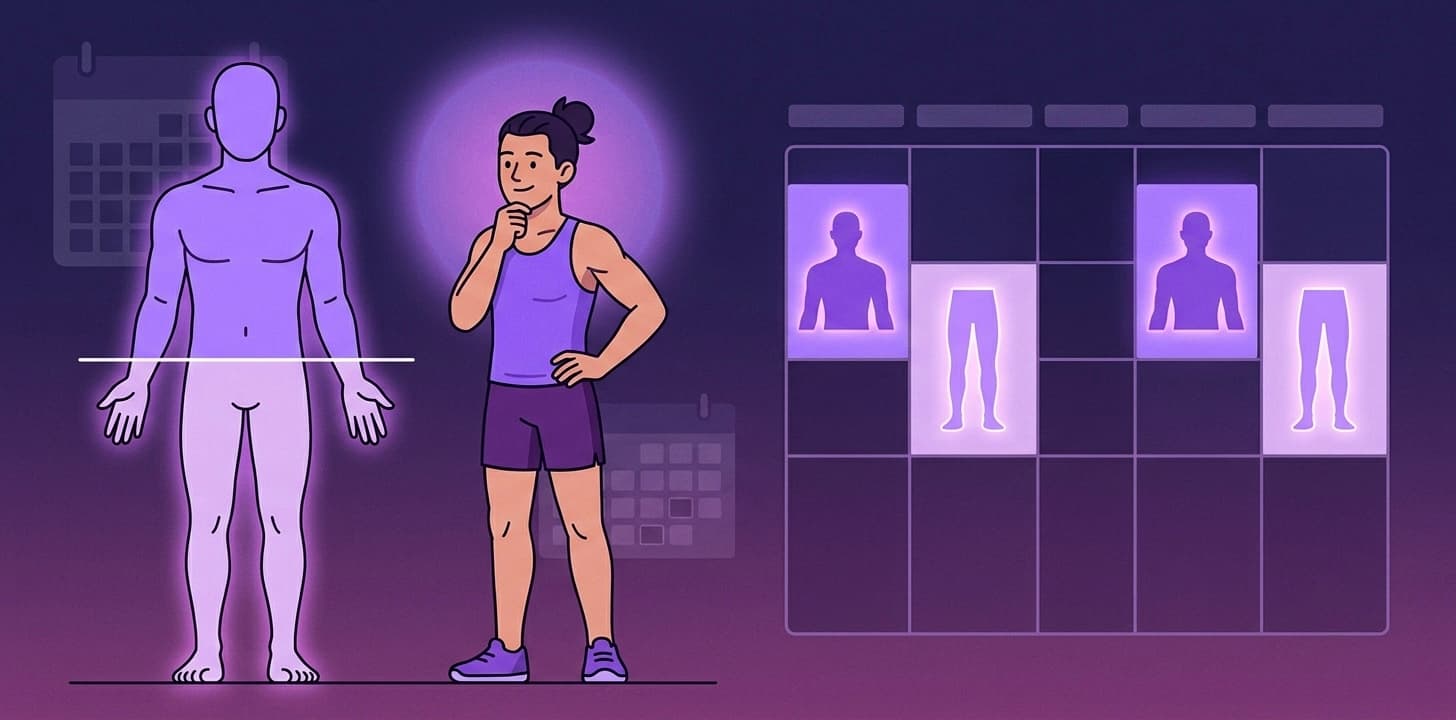
Four training days per week opens the door to the upper/lower split. You alternate between upper body sessions and lower body sessions, running each twice per week:
| Day | Session |
|---|---|
| Monday | Upper A |
| Tuesday | Lower A |
| Thursday | Upper B |
| Friday | Lower B |
This setup hits every muscle group twice per week while giving you more room per session than full body allows. Upper days can include 5–7 exercises covering chest, back, shoulders, and arms. Lower days can include 4–6 exercises covering quads, hamstrings, glutes, and calves.
The A/B distinction is important. Upper A might emphasize horizontal pressing (bench press) and rowing, while Upper B emphasizes vertical pressing (overhead press) and pull-ups. Lower A could be quad-dominant (squats, leg press), while Lower B is hip-dominant (deadlifts, hip thrusts). This variation distributes stress across different movement patterns and helps manage joint fatigue.
Upper/lower is the workhorse split for intermediate lifters. It scales well from 12 to 20+ sets per muscle group per week, accommodates both strength and hypertrophy goals, and leaves three full rest days for recovery. If you are not sure what to run and you can train four days, start here. The upper/lower split guide covers programming in detail.
5 Days Per Week: Hybrid Approaches
Five days is an awkward number for traditional splits. PPL needs six days for a full rotation. Upper/lower needs four. So five-day programs tend to use hybrid structures.
The most common options:
Upper/Lower/Push/Pull/Legs — Run a standard upper/lower pair on Monday and Tuesday, rest Wednesday, then run a PPL-style push/pull/legs rotation Thursday through Saturday. Each muscle gets hit twice per week with slightly different stimuli.
Upper/Lower + Arms/Shoulders — Four days of upper/lower plus a fifth session dedicated to lagging body parts. This works well for intermediate lifters whose arms or shoulders are falling behind.
Full Body + Upper/Lower — Three full body sessions plus two sessions focused on upper or lower body weaknesses. This is less common but effective if you want high frequency on compounds while adding targeted accessory work.
Five-day programs require more careful planning to avoid overreaching. You only have two rest days, and if those rest days land poorly (e.g., three consecutive training days), recovery can suffer. Arrange your schedule so you never train more than three days in a row.
6 Days Per Week: Push Pull Legs
Six days per week is the domain of PPL. You run the three-day Push/Pull/Legs cycle twice, rest on Sunday, and repeat. This is arguably the most popular split among serious recreational lifters, and for good reason: it delivers twice-per-week frequency on every muscle group, allows plenty of volume per session, and the movement-pattern grouping reduces overlap between sessions.
For a full breakdown of exercise selection, volume, and periodization, read the Push Pull Legs guide.
The main prerequisite for PPL is not just schedule availability but recovery capacity. Six hard sessions per week demands solid sleep (7–9 hours), adequate nutrition, and managed life stress. If you are sleeping five hours, eating inconsistently, and working sixty-hour weeks, four sessions of upper/lower will outperform six sessions of PPL because you will actually recover between them.
The Bro Split: Why It Usually Falls Short
The classic "bro split" dedicates one day to each muscle group — chest Monday, back Tuesday, shoulders Wednesday, legs Thursday, arms Friday. Each body part gets annihilated once per week with high volume.
It is popular. It is also usually suboptimal.
The main issue is frequency. Training a muscle once per week means you get 52 growth-stimulating sessions per muscle per year. Training it twice per week gives you 104. The Schoenfeld meta-analysis found a clear dose-response relationship between weekly frequency and hypertrophy, with twice-per-week training producing roughly 3.1% greater gains in muscle thickness compared to once-per-week training, even when total weekly sets were equated.
There is also a practical problem with the bro split: the volume-per-session issue. If you need 16 sets for chest per week and you are doing all 16 in one session, the last several sets are performed in a fatigued state where motor unit recruitment and mechanical tension are compromised. Splitting those 16 sets across two sessions (8 sets each) means higher quality reps across the board.
That said, the bro split is not useless. For advanced bodybuilders who need 20+ sets per muscle group per week and train with very high intensity techniques (drop sets, rest-pause, forced reps), concentrating that volume in one session with a full week of recovery can work. But for intermediate lifters training at moderate to high effort? The bro split is leaving gains on the table.
Factor in Your Training Experience
Schedule is the primary filter, but experience level adjusts the recommendation.
Beginners (under 6 months of consistent training): Full body, three days per week. The priority is learning movement patterns, and full body gives you three practice sessions per week on every major lift. You also do not need much volume to grow — 6 to 10 hard sets per muscle group per week is plenty. A three-day full body program handles that in roughly 45-minute sessions.
Intermediates (6 months to 2+ years): Upper/lower at four days or PPL at six days. You need more volume than a beginner (12–18 sets per muscle group per week) and benefit from exercise variety between sessions. Both splits deliver twice-per-week frequency.
Advanced (2+ years, approaching genetic potential): Higher frequency and higher volume become increasingly necessary. PPL, Arnold splits (chest/back, shoulders/arms, legs — twice per week), or specialized programs targeting lagging body parts become relevant. Recovery management — deload weeks, periodization, and sleep optimization — matters more than the specific split chosen.
Factor in Your Primary Goal
Your goal adjusts exercise selection and rep ranges within the split more than it changes the split itself, but there are a few relevant considerations.
Hypertrophy (muscle growth): Frequency of twice per week is ideal. Any split that delivers this works — full body, upper/lower, or PPL. Higher total volume (15–20+ sets per muscle per week for intermediates) tends to produce more growth, so splits that allow more session time are slightly advantageous.
Strength (1RM improvement): The big barbell lifts need practice. Full body or upper/lower programs that place squat, bench, deadlift, and overhead press early in sessions — when you are freshest — tend to work best. You can still train for strength on PPL, but the split does not inherently prioritize powerlifting specificity.
General fitness/body recomposition: Full body three to four days per week. It is efficient, leaves ample time for cardio or sport practice on off days, and provides enough stimulus for muscle retention during a caloric deficit.
The Complete Comparison
Here is every major split side by side:
| Split | Days/Week | Frequency per Muscle | Best For | Main Limitation |
|---|---|---|---|---|
| Full Body | 2–3 | 2–3x/week | Beginners, busy schedules | Long sessions at high volume |
| Upper/Lower | 4 | 2x/week | Intermediates, balanced goals | Less specialization |
| PPL | 6 | 2x/week | Intermediates/advanced, hypertrophy | High time commitment |
| Hybrid (5-day) | 5 | 2x/week | Intermediates with specific weaknesses | Requires careful planning |
| Bro Split | 5–6 | 1x/week | Advanced bodybuilders, high intensity | Low frequency, suboptimal for most |
| Arnold Split | 6 | 2x/week | Advanced, high volume tolerance | Very demanding recovery |
Making the Switch
If you are currently running one split and this framework suggests a different one, do not overthink the transition. Finish your current training week, then start the new split the following Monday. There is no need for a deload or transition period unless you are dramatically increasing training frequency (e.g., going from three days to six). In that case, run the first two weeks at roughly 70% of your planned volume to let your body adapt to the new schedule.
Track your lifts, track your recovery, and give any new split at least six to eight weeks before evaluating whether it is working. Muscle growth is slow. Program hopping every three weeks is one of the most common reasons intermediate lifters stall. Pick a split, commit to it, and let the data tell you whether to adjust.