The Conjugate Method: Westside Barbell's Training System Explained
10 min read · May 2025 · by Manikanta Sirumalla
The Conjugate Method: Westside Barbell's Training System Explained
The conjugate method is the most successful strength training system in powerlifting history. Developed and refined by Louie Simmons at Westside Barbell in Columbus, Ohio, this system has produced more elite-level powerlifters than any other gym or program in the world, including multiple all-time world records across weight classes.
But the conjugate method is not just for powerlifters. Its underlying principles (training multiple physical qualities simultaneously, rotating exercises to prevent accommodation, and using accommodating resistance to address sticking points) are applicable to any serious strength trainee. This guide breaks down the entire system.
The Theory Behind Conjugate Training
The conjugate method is rooted in two key physiological principles:
The Law of Accommodation (Zatsiorsky). The response of a biological system to a constant stimulus decreases over time. In practical terms: if you bench press the same way every week, your body stops adapting. The conjugate method combats this by rotating the primary exercise every one to three weeks. You might max effort floor press one week, two-board press the next, and close-grip bench the following week. The movement pattern is similar enough to transfer to the competition lift, but different enough to provide a novel stimulus.
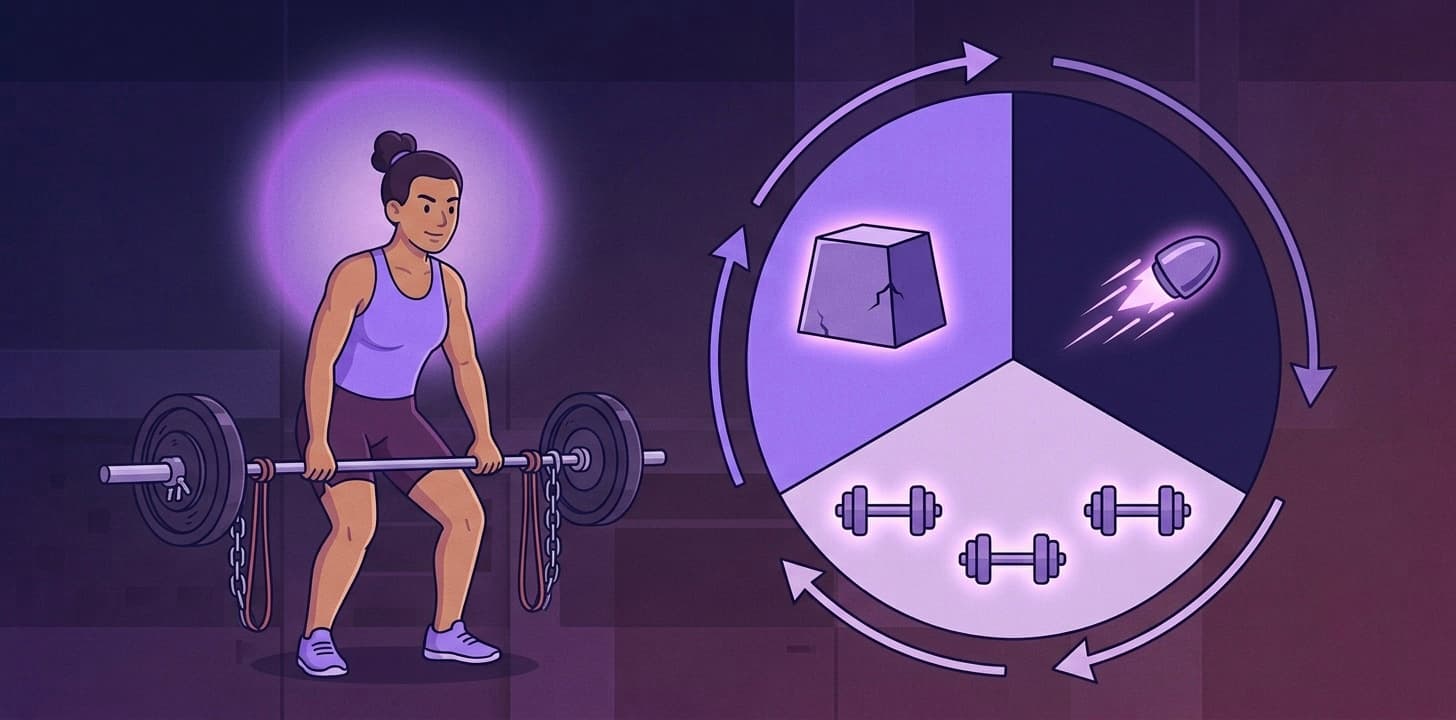
Concurrent Training of Multiple Qualities. Traditional periodization models train one quality at a time: hypertrophy for a block, then strength, then speed. The conjugate method trains all three simultaneously within each training week. This ensures no quality is detrained while another is being developed. Simmons adapted this approach from the Soviet conjugate sequence method used by Verkhoshansky and other Eastern Bloc coaches.
The Four-Day Training Structure
The conjugate method uses four training sessions per week, split into two pairs:
Max Effort Upper (Monday)
The goal is to work up to a 1-3 rep maximum on a barbell pressing variation. This trains absolute strength: the ability to produce maximal force regardless of speed.
| Component | Details |
|---|---|
| Main movement | Work up to a 1-3RM on a pressing variation |
| Exercise rotation | Change the main movement every 1-3 weeks |
| Volume | Multiple warm-up sets, 1-3 top sets |
| Accessories | Triceps, shoulders, upper back, lats: 3-5 exercises of 3-4 sets |
Example pressing variations (rotate weekly):
- Two-board bench press
- Floor press
- Close-grip bench press
- Incline barbell press
- Bench press with chains
- Bench press against bands
- Swiss bar bench press
Max Effort Lower (Wednesday or Thursday)
Same concept applied to a squat or deadlift variation. Work up to a heavy 1-3 rep max.
| Component | Details |
|---|---|
| Main movement | Work up to a 1-3RM on a squat or deadlift variation |
| Exercise rotation | Change the main movement every 1-3 weeks |
| Volume | Multiple warm-up sets, 1-3 top sets |
| Accessories | Hamstrings, glutes, lower back, abs: 3-5 exercises of 3-4 sets |
Example lower variations (rotate weekly):
- Box squat (various heights)
- Front squat
- Safety squat bar squat
- Deficit deadlift
- Block pulls (rack pulls)
- Sumo deadlift
- Good mornings (various stances)
Dynamic Effort Upper (Wednesday if ME Lower is Thursday, or Sunday)
The goal is to move a submaximal load as fast as possible. This trains rate of force development: the ability to produce force quickly, which is critical for breaking through sticking points.
| Component | Details |
|---|---|
| Main movement | Bench press: 8-9 sets of 3 reps at 50-60% 1RM |
| Accommodating resistance | Add bands or chains equal to 20-25% of 1RM at lockout |
| Rest between sets | 45-60 seconds |
| Tempo | Controlled eccentric, maximum effort concentric |
| Accessories | Triceps, shoulders, upper back: 3-5 exercises of 3-4 sets |
Dynamic Effort Lower (Saturday or Sunday)
| Component | Details |
|---|---|
| Main movement | Box squat: 10-12 sets of 2 reps at 50-60% 1RM |
| Accommodating resistance | Bands or chains adding 20-25% of 1RM at the top |
| Rest between sets | 45-60 seconds |
| Tempo | Sit on box, pause briefly, explode up with maximum velocity |
| Accessories | Hamstrings, glutes, lower back, abs: 3-5 exercises of 3-4 sets |
Accommodating Resistance: Bands and Chains
Accommodating resistance is a defining feature of the conjugate method. Bands and chains alter the resistance curve of an exercise to match the body's natural strength curve.
Chains
Chains pile on the floor when the bar is at the bottom of the lift and progressively add weight as you lift. A typical setup:
- Squat with 315 lb bar weight + 80 lb of chain (40 lb per side)
- At the bottom of the squat, most chain is on the floor: effective load is approximately 315 lb
- At lockout, all chain is suspended: effective load is 395 lb
This overloads the lockout (where you are mechanically strongest) while deloading the bottom (where you are weakest and most vulnerable). The result is more consistent tension throughout the range of motion.
Bands
Bands work similarly but add acceleration: the resistance increases exponentially as the band stretches. Bands also create an eccentric overload because the band pulls the bar down faster than gravity alone, forcing more aggressive deceleration.
Common band setups:
| Band Color (typical) | Added Resistance at Top | Best For |
|---|---|---|
| Mini band | 30-50 lb per pair | Bench press speed work |
| Monster mini | 50-80 lb per pair | Squat speed work, bench press |
| Light band | 60-100 lb per pair | Squat speed work |
| Average band | 100-150 lb per pair | Heavy squat and deadlift work |
The Accessory Work System
Accessory work in the conjugate method is not an afterthought: it is where most of the training volume lives. Simmons prescribed high-volume accessory work targeting weak points, following this hierarchy:
Priority Muscle Groups and Their Role
Triceps (for bench press): The triceps are the primary mover in the lockout phase of the bench press. Westside athletes commonly perform 12-20 sets of tricep work per week across both upper body sessions. Exercises: close-grip pushdowns, JM press, skull crushers, dumbbell extensions.
Hamstrings and Glutes (for squat and deadlift): The posterior chain drives hip extension, which is the engine of both lifts. Exercises: glute-ham raises, reverse hypers, pull-throughs, Romanian deadlifts, belt squats.
Upper Back and Lats (for all three lifts): A thick upper back stabilizes the bench press and supports the squat. Strong lats keep the bar close during the deadlift. Exercises: face pulls, band pull-aparts, chest-supported rows, lat pulldowns.
Lower Back and Core: Spinal erector strength and core stability are foundational for heavy squatting and deadlifting. The reverse hyper machine (invented by Simmons) is a staple.
Accessory Programming Guidelines
- Perform 3-5 accessory exercises after each main movement
- Use 3-4 sets of 8-20 reps depending on the exercise
- Target your individual weak points: if your bench press fails at lockout, prioritize tricep work; if your deadlift stalls off the floor, prioritize quad and upper back work
- Rotate accessories every 2-4 weeks to prevent accommodation
Applying the Conjugate Method Beyond Powerlifting
You do not need to be a competitive powerlifter to benefit from conjugate principles. Here is how to adapt the system for general strength and hypertrophy:
For General Strength Athletes
- Keep the four-day structure but replace competition lifts with movements relevant to your sport
- Max effort work builds absolute strength applicable to any physical endeavor
- Dynamic effort work develops explosiveness: valuable for team sports, combat sports, and athletics
- Increase accessory volume and rep ranges (12-20 reps) to drive more hypertrophy
For Bodybuilders
- Use max effort days to build baseline strength on compound movements
- Replace dynamic effort days with high-volume hypertrophy sessions (similar to German Volume Training principles)
- Expand accessory work to 5-7 exercises per session targeting specific muscle groups
- Use the exercise rotation principle to hit muscles from multiple angles across weeks
For Recreational Lifters
A simplified conjugate template works well for anyone with at least one year of training experience:
| Day | Type | Main Movement | Accessory Focus |
|---|---|---|---|
| Monday | Max Effort Upper | Heavy press variation, work to 3RM | Triceps, shoulders, upper back |
| Tuesday | Max Effort Lower | Heavy squat or pull variation, work to 3RM | Hamstrings, glutes, core |
| Thursday | Repetition Upper | Bench press 4 x 8-12 | Chest, shoulders, arms |
| Friday | Repetition Lower | Squat variation 4 x 8-12 | Quads, hamstrings, calves |
This "repetition method" replacement for dynamic effort days is more appropriate for lifters without access to bands, chains, or the technical knowledge to execute speed work properly.
Common Mistakes
Not rotating exercises on max effort days. The entire point of the conjugate system is to prevent accommodation. Using the same lift for more than three consecutive weeks defeats the purpose. Rotate.
Treating dynamic effort days as light days. Speed work is not easy work: the intent is maximum force production against a submaximal load. Every rep should be explosively violent. If you are casually pressing the bar, you are missing the stimulus.
Neglecting accessory work. At Westside, accessory work occupies more total training time than the main movements. Skipping accessories because you are tired from the main lift is like building a house with no foundation.
Going too heavy on dynamic effort. Speed work at 75-80% 1RM is no longer speed work: it is grinding. Stay at 50-60% bar weight plus accommodating resistance.