Upper/Lower Split: The 4-Day Program That Actually Works
9 min read · April 2025 · by Manikanta Sirumalla
Upper/Lower Split: The 4-Day Program That Actually Works
A six-day Push Pull Legs split is great on paper — until your schedule, recovery capacity, or life outside the gym makes it unsustainable. The Upper/Lower split solves this cleanly: four sessions per week, every muscle group trained twice, and three full rest days built into the schedule. For intermediate lifters who can commit to four gym days (and not a session more), it is arguably the most efficient split available.
The Structure
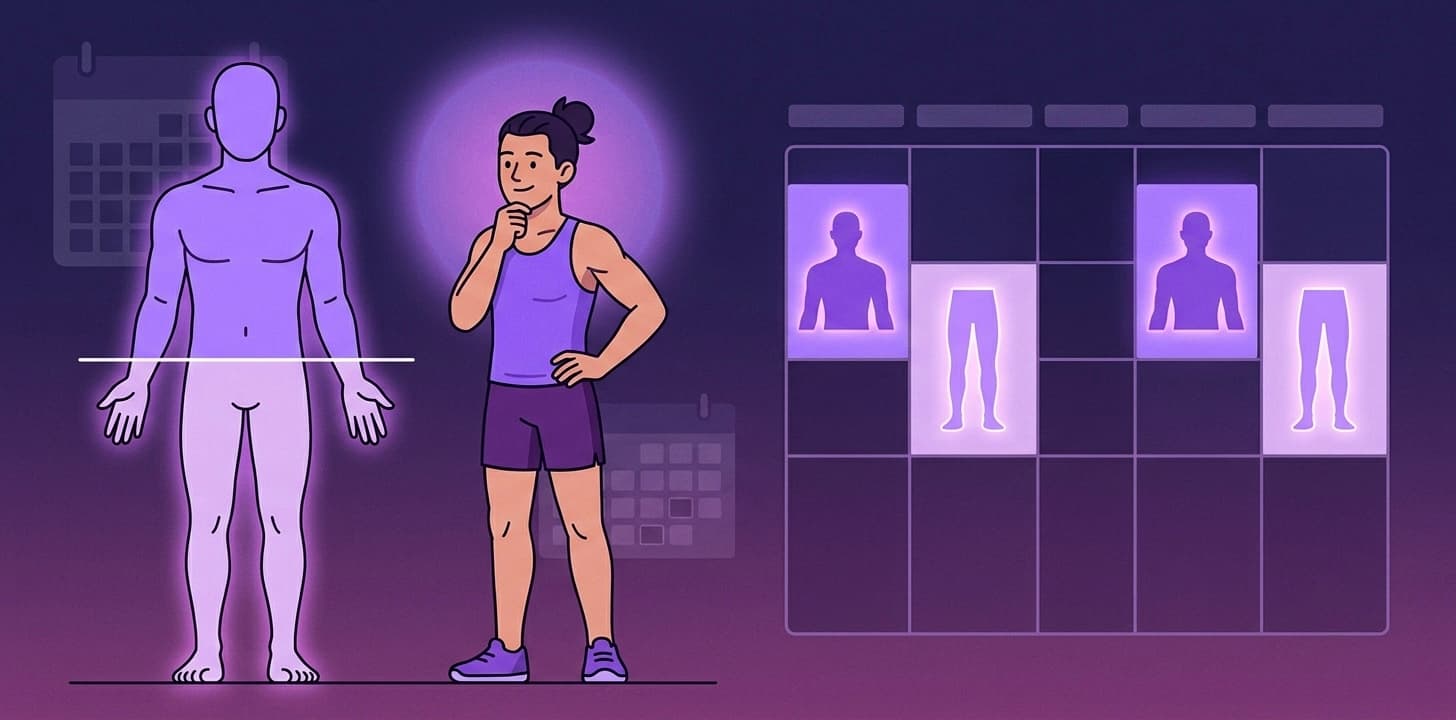
Upper/Lower divides your training into two categories:
- Upper days — all pressing and pulling movements for the chest, back, shoulders, and arms.
- Lower days — squats, hinges, and all lower-body work for quads, hamstrings, glutes, and calves.
You run four sessions per week with the following layout:
| Day | Session | Focus |
|---|---|---|
| Monday | Upper A | Strength emphasis (heavier compounds) |
| Tuesday | Lower A | Quad-dominant, heavier squats |
| Wednesday | Rest | — |
| Thursday | Upper B | Hypertrophy emphasis (moderate loads, higher reps) |
| Friday | Lower B | Posterior chain emphasis, heavier hinges |
| Saturday | Rest | — |
| Sunday | Rest | — |
The Mon/Tue and Thu/Fri pairing is deliberate. Training upper body and lower body on consecutive days means no single muscle group works two days in a row, so local recovery is never compromised. The Wednesday rest day breaks up the week and prevents systemic fatigue from stacking.
Like a well-structured PPL program, the A/B distinction within each day type is critical. Upper A and Upper B are not the same workout — they vary in exercise selection, rep ranges, and loading intensity. This keeps your training stimulus diverse while still allowing you to track progressive overload on consistent movements.
Who Should Run Upper/Lower?
This split fits three profiles particularly well:
Intermediate lifters with 6-12 months of experience. You have graduated from a beginner full-body program, you are comfortable with compound lifts, and you need more volume per muscle group than three full-body sessions can provide. Upper/Lower gives you that extra volume without demanding six days in the gym.
Lifters over 30 who need more recovery. Recovery slows with age — that is not opinion, it is physiology. Testosterone and growth hormone levels decline roughly 1% per year after age 30, and connective tissue takes longer to repair. Three rest days per week makes a measurable difference for this population compared to a 6-day PPL.
Anyone whose schedule only allows four training days. Work, family, commute — whatever the reason, if five or six gym days is unrealistic, trying to squeeze PPL into four days means either dropping frequency (training each muscle once per week) or running absurdly long sessions. Neither is optimal. Upper/Lower is designed for exactly this constraint.
Balancing Push and Pull Volume on Upper Days
The biggest programming mistake on upper days is turning them into "chest and shoulders day with some back work at the end." Your upper body sessions need balanced push and pull volume — ideally a 1:1 ratio of pressing sets to pulling sets. Here is why: the shoulder joint is inherently unstable, and chronic imbalances between anterior pushing muscles and posterior pulling muscles are the leading cause of shoulder impingement in recreational lifters.
A practical approach: each upper day should include 4-5 exercises total, split roughly evenly between pressing and pulling movements.
Upper A (Strength Emphasis)
| Order | Exercise | Sets x Reps | Notes |
|---|---|---|---|
| 1 | Barbell bench press | 4 x 5 | RPE 8, primary push compound |
| 2 | Barbell row | 4 x 5 | RPE 8, primary pull compound |
| 3 | Seated dumbbell overhead press | 3 x 8 | Secondary push |
| 4 | Weighted pull-ups | 3 x 6-8 | Secondary pull |
| 5 | Lateral raises | 3 x 15 | Side delt isolation |
Upper B (Hypertrophy Emphasis)
| Order | Exercise | Sets x Reps | Notes |
|---|---|---|---|
| 1 | Incline dumbbell press | 3 x 10 | Moderate load, upper chest bias |
| 2 | Cable row | 3 x 10-12 | Horizontal pull, controlled tempo |
| 3 | Machine chest press or dips | 3 x 12 | Higher rep push |
| 4 | Lat pulldown | 3 x 10-12 | Vertical pull |
| 5 | Face pulls | 3 x 15 | Rear delt and rotator cuff health |
| 6 | Tricep pushdowns + Hammer curls | 2 x 12 each | Superset for efficiency |
Notice that Upper A has 7 pushing sets and 7 pulling sets. Upper B has 6 pushing sets and 6 pulling sets, plus the face pull and arm superset. Weekly upper body volume lands at roughly 13 push sets and 13 pull sets — right in the productive range for intermediates. If you want to understand why compound movements anchor every session, the answer is efficiency: a single set of bench press trains chest, anterior delts, and triceps simultaneously, meaning you accumulate effective volume faster.
Lower Day Programming
Lower days follow a similar A/B structure, but divided by movement emphasis rather than just intensity.
Lower A (Quad Dominant)
| Order | Exercise | Sets x Reps | Notes |
|---|---|---|---|
| 1 | Barbell back squat | 4 x 5 | RPE 8, primary compound |
| 2 | Romanian deadlift | 3 x 8 | Hamstring hinge, moderate load |
| 3 | Bulgarian split squats | 3 x 10 each leg | Unilateral quad work |
| 4 | Leg curl | 3 x 12 | Hamstring isolation |
| 5 | Standing calf raises | 3 x 12 | Full range of motion |
Lower B (Posterior Chain Dominant)
| Order | Exercise | Sets x Reps | Notes |
|---|---|---|---|
| 1 | Conventional or sumo deadlift | 3 x 5 | RPE 8, primary hinge |
| 2 | Leg press | 3 x 10 | Quad volume without spinal loading |
| 3 | Walking lunges | 3 x 12 each leg | Unilateral, glute emphasis |
| 4 | Leg extension | 3 x 12-15 | Quad isolation |
| 5 | Hip thrust | 3 x 10 | Glute focus |
| 6 | Seated calf raises | 3 x 15 | Soleus emphasis |
Weekly lower body volume: approximately 16-17 quad sets and 12-13 hamstring/glute sets when you count compounds that train both (squats hit quads and glutes, RDLs hit hamstrings and glutes). This is well within the recoverable range for a 4-day program.
Upper/Lower vs. PPL: When to Choose Which
The comparison comes down to available training days and recovery capacity:
| Factor | Upper/Lower (4 days) | PPL (6 days) |
|---|---|---|
| Weekly frequency per muscle | 2x | 2x |
| Total weekly sets | ~55-65 | ~90-105 |
| Rest days per week | 3 | 1 |
| Session length | 50-65 minutes | 45-60 minutes |
| Recovery demand | Moderate | High |
Both splits hit each muscle group twice per week — the frequency is identical. The difference is total volume. PPL allows roughly 40-50% more weekly sets because you have two additional sessions. For advanced lifters who need that volume to progress, PPL is the better choice. For everyone else, Upper/Lower delivers the same frequency benefit with significantly less time investment and fatigue cost.
One often-overlooked advantage of Upper/Lower: session density. Because you are training the entire upper body in one session (as opposed to just "push" or "pull"), you can superset opposing movements — bench press with barbell rows, overhead press with pull-ups. This cuts session time without reducing volume.
How to Progress
The double progression method works exceptionally well for Upper/Lower because you have clear, repeating exercises to track week over week.
For heavy compounds (squat, bench, deadlift, row at 4-5 reps):
- Add 2.5-5 lbs per week on upper body lifts
- Add 5-10 lbs per week on lower body lifts
- When you can no longer add weight at the target RPE, deload for one week (reduce volume by 40-50%, keep intensity the same) and reset
For moderate-rep exercises (8-12 reps):
- Use double progression: stay at the same weight until you hit the top of the rep range on all sets, then increase by 5 lbs (upper) or 10 lbs (lower)
- This gives you 2-4 weeks of progression at the same weight before a load increase
For isolation work (12-15 reps):
- Progress by adding 1 rep per set each week
- Increase load only when you comfortably hit the top of the range with controlled form
A realistic progression timeline: an intermediate lifter on Upper/Lower can expect to add roughly 20-30 lbs to their squat and deadlift over a 12-week training block, and 10-15 lbs to their bench press and row. These numbers assume adequate nutrition (at least 0.8 g of protein per pound of body weight) and consistent sleep (7-9 hours nightly).
Sample 4-Week Block
Here is what progression looks like in practice for the barbell bench press across a mesocycle:
| Week | Upper A (Bench) | Upper B (Incline DB) |
|---|---|---|
| Week 1 | 185 lbs, 4x5 | 60 lbs, 3x10 |
| Week 2 | 187.5 lbs, 4x5 | 60 lbs, 3x11 |
| Week 3 | 190 lbs, 4x5 | 60 lbs, 3x12 |
| Week 4 (deload) | 190 lbs, 2x5 | 50 lbs, 2x10 |
| Week 5 (new block) | 190 lbs, 4x5 | 65 lbs, 3x10 |
The strength exercise progresses via load. The hypertrophy exercise progresses via reps, then resets with a heavier weight. Both are progressive overload — just applied differently based on the rep range and training goal.
Run this program for 12-16 weeks with consistent deloads every fourth week, and you will have a clear, trackable record of progress. When the four-day schedule eventually feels too easy — when your work capacity has grown enough that you want more volume — that is the signal to consider moving to a Push Pull Legs split.