Wrist Temperature: Your Nightly Baseline Shift
7 min read · August 2026 · by Manikanta Sirumalla
Wrist Temperature: Your Nightly Baseline Shift
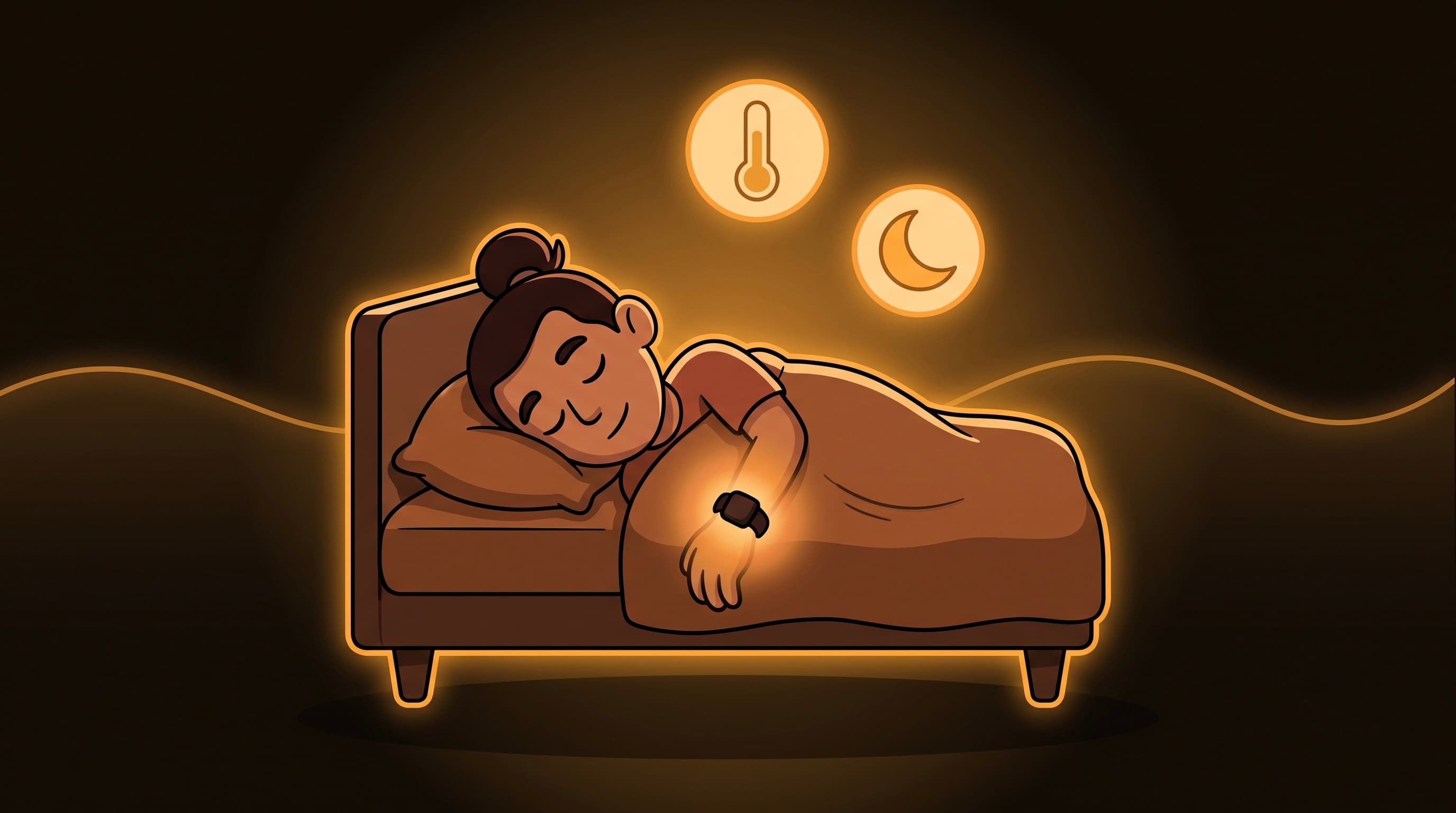
Since Series 8, Apple Watch has measured wrist temperature while you sleep: not a forehead thermometer reading, but a consistent overnight sample taken at the same place on your body every night. That consistency is the point: absolute wrist temperature isn't very meaningful compared to other people, but how much yours shifted from your own recent baseline is a surprisingly useful signal for training load, illness, environment, and (where relevant) menstrual cycle phase.
RepTrack shows wrist temperature on the Health Monitor grid and folds a small slice into Recovery when your history is mature. This article covers what the number is, how the personal band works, and how to read shifts without over-interpreting them.
What the watch measures
Apple Watch reports wrist temperature in degrees Celsius (RepTrack displays °C on the metric page; HealthKit stores the absolute value). The sensor reads during sleep periods with sleep tracking enabled, it is a nightly vital, not a daytime spot check.
Important boundaries:
- It is not core body temperature. Wrist skin temperature runs cooler and responds to blankets, room heat, and watch fit.
- It is most useful as a deviation signal: tonight vs your last two weeks, which is exactly how RepTrack's personal band and Recovery engine treat it.
- Series 8 or later with sleep tracking is required. Older watches produce no data, and RepTrack shows the honest empty state rather than a fabricated number.
What you see in Health Analytics
On the Wrist Temp tab:
- Today's nightly reading (°C, one decimal).
- Line chart over week / month / six months.
- 7-day average and range for the window.
- Personal band from 30 days of readings (median ± robust spread; needs at least four points).
- % vs last month, reported with neutral tone: like respiratory rate, wrist temperature moves for too many reasons to label every "above usual" as bad or every "below usual" as good.
Until the band exists, the monitor tile reads "Collecting your baseline." A reading without a band still shows the value; RepTrack won't invent a "typical" range.
How Recovery uses it (5%, baseline-only)
Wrist temperature is a 5% supporting input to Recovery, same weight class as respiratory rate. Rules:
- Requires a mature personal baseline (≥7 days of history) before it influences the score.
- Elevation above your baseline is the meaningful direction (illness, inflammation, heavy training block, luteal-phase shift for many cycle-trackers).
- Cooler than baseline gets capped upward influence, the engine won't treat an unusually cold wrist as strong proof of superb recovery.
- Values outside 30–45 °C are discarded as implausible so bad samples don't enter the baseline.
It never scores Recovery alone. You still need HRV, resting heart rate, or sleep as a core signal.
What commonly shifts your nightly wrist temperature
Training and recovery
- A very hard session or short sleep after travel can leave wrist temperature slightly elevated for a night or two, the same "still under load" story resting heart rate tells.
Illness and immune response
- Fevers show up indirectly; even before you feel fully sick, sustained elevation across several nights alongside faster respiratory rate and higher resting heart rate is a classic cluster.
Environment
- Heavy blankets, heated rooms, or wearing the watch too loosely (poor thermal contact) can nudge readings. Consistent fit and bedroom conditions make trends cleaner.
Menstrual cycle (where applicable)
- Many people see a post-ovulation rise in overnight wrist temperature, Apple builds cycle retrospective ovulation estimates partly from this signal. RepTrack's cycle features and wrist temperature can tell complementary stories; the Health Monitor vital is still neutral-graded because the same rise is not "bad," it's context.
Alcohol
- Late alcohol often elevates overnight skin temperature and fragments sleep, wrist temp, HRV, and recovery frequently move together the next morning.
Because causes overlap, RepTrack reports position and trend without picking one explanation.
Missing data: the honest causes
If Wrist Temp is always empty:
- Watch generation: Series 8, 9, 10, or Ultra lines with sleep tracking.
- Sleep tracking enabled: the watch needs defined sleep periods to associate samples.
- Overnight wear: the metric is nightly by construction.
- Health read permission for wrist temperature / body temperature types in iOS Settings.
The metric page lists these in plain language, including the fact that iOS never tells RepTrack which Health types were denied: only Settings can confirm permissions.
How to actually use it
- Think in deltas, not absolutes. "0.3 °C above my usual band for three nights" beats "it's 36.2 °C."
- Cluster with other vitals. Respiratory rate + resting HR + wrist temp moving together is stronger evidence than any one line.
- Cycle-aware users: expect phase-driven shifts; compare within-phase weeks when you can.
- Don't medicalize noise. One warm night after spicy food and a thick duvet is not illness.
- Clinical fever questions use clinical tools. RepTrack is for training readiness trends, not diagnosing infection.
The bottom line
Wrist temperature in RepTrack is your nightly deviation signal: read from Apple Health, shown against your 30-day personal band, compared month-over-month without moralizing the direction, and blended lightly into Recovery when your baseline is ready. It shines when watched as a multi-night pattern alongside the other sleep vitals, not as a single absolute number on its own.
Sources
- Apple Support, Wrist temperature during sleep (Series 8+, setup, limitations).
- Apple HealthKit, sleeping wrist temperature sample types and sleep association.
- Baker FC, et al. "Sleep and sleep disorders in the menstrual cycle." Sleep Medicine Reviews, 2012, cycle-linked temperature variation.
- RecoveryEngine D.1.5 gate documentation, baseline-relative wrist temperature scoring.
- Oura / WHOOP product documentation, skin temperature deviation as a readiness input.