No Wearable? Here's How RepTrack Reads Your Training Readiness
6 min read · July 2026 · by Manikanta Sirumalla

No Wearable? Here's How RepTrack Reads Your Training Readiness
You don't need a $300 wristband to know whether today should be a push day or a back-off day. But you should know exactly what your app is (and isn't) measuring when it tells you.
Why we don't fake a recovery score
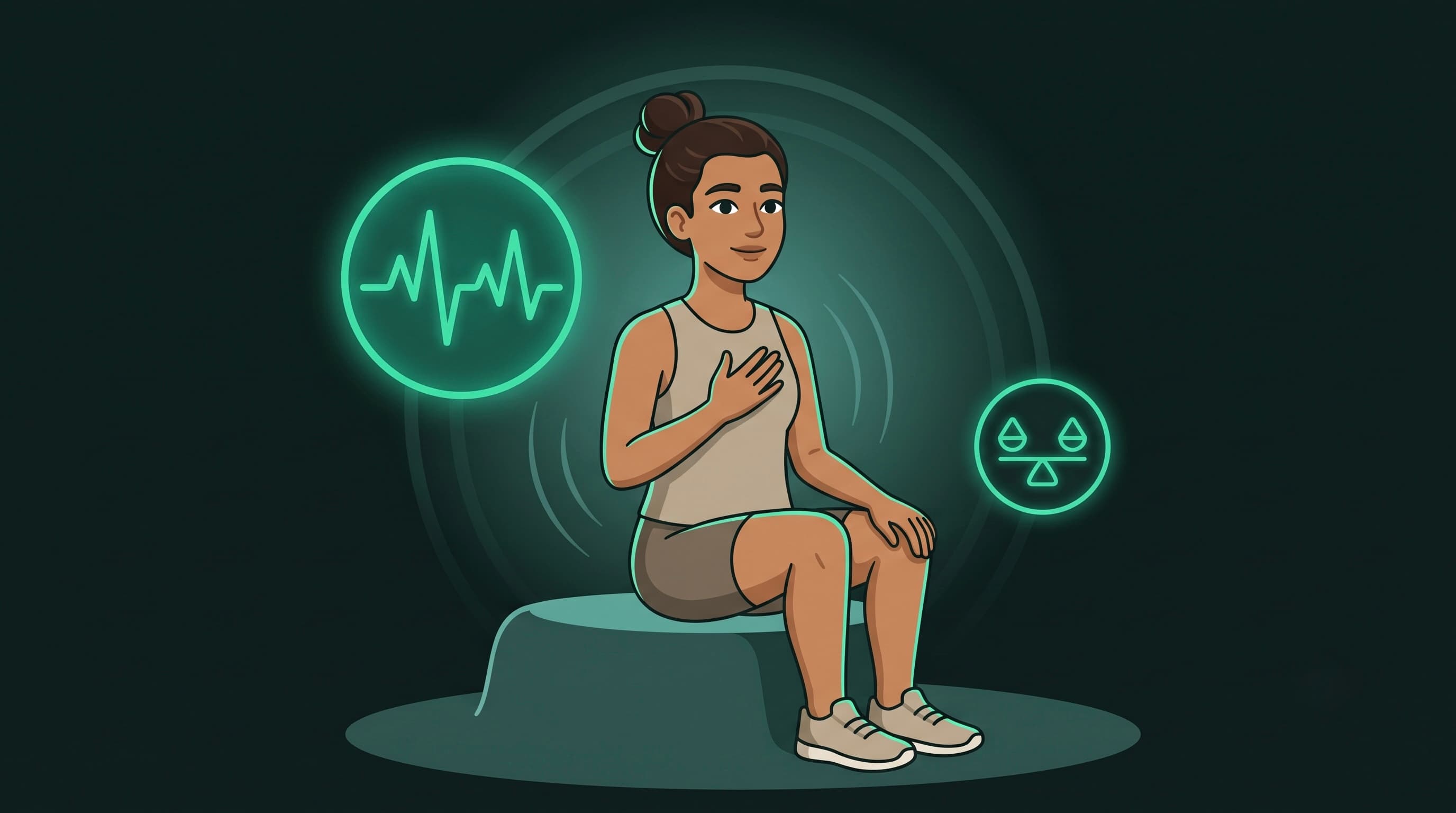
If you're training with just your iPhone, RepTrack will never show you a physiological "recovery" number. No HRV percentage, no sleep-adjusted readiness ring, no green/yellow/red battery pulled out of thin air. Here's the part most apps get wrong: they show you a confident-looking recovery score whether or not they have the sensor data to back it up. A number with nothing behind it isn't information: it's decoration.
That's the honesty contract. Recovery, in the physiological sense, means reading signals from your body: heart-rate variability (HRV, the tiny beat-to-beat timing changes that track your nervous system's stress load), resting heart rate, sleep architecture, respiratory rate. Your phone can't measure any of those. So instead of inventing them, RepTrack gives iPhone-only users something it can actually stand behind: Training Readiness, and it labels it that way on purpose.
The distinction isn't pedantic. "Recovery" is a claim about your nervous system and physiology. "Readiness" is a claim about your training: how recently you trained, how hard your recent load has been relative to normal, and how you say you feel. One is a body signal. The other is a training-log inference. Calling the second one "recovery" would be lying to you: a readiness score you can trust beats a recovery score you can't.
What actually goes into Training Readiness
Three inputs, all derived from data RepTrack genuinely has: your logged workouts and your own optional rating.
1. Session freshness
The simplest signal: how long since your last workout, measured against a rough recovery window. Train legs hard four hours ago and readiness reads low, not because something's wrong, but because you haven't had time to recover yet. Two full rest days out from your last session and freshness stops holding you back. This is the "have you actually rested?" input, and it's the one every lifter already intuits.
2. Training-load balance (the acute:chronic workload ratio)
This is the one worth understanding. RepTrack compares your acute load, roughly this week's training tonnage (sets × reps × weight), against your chronic load, your rolling four-week average. The ratio of the two is the acute:chronic workload ratio, or ACWR.
The idea: your body adapts to what it's used to. If this week looks like your last month, the ratio sits near 1.0 and you're training in a sustainable groove. Spike this week's volume far above your four-week average (a ratio well above ~1.3) and you're in territory associated with higher injury risk in some studies. Drop far below it (under ~0.8) and you may be detraining, or just deloading, which is fine and intentional. The rough sweet spot RepTrack watches for is 0.8 to 1.3.
Here's the honest caveat, because RepTrack's whole differentiator is not overselling: ACWR is a useful heuristic, not a law. The concept comes largely from Tim Gabbett's work in team-sport athletes (Gabbett 2016), and it's been genuinely contested since: critics have flagged statistical artifacts, arbitrary window choices, and weak transfer to individual lifters (Impellizzeri et al. 2020). Treat it as a smoke detector, not a diagnosis. When your ratio spikes, that's a reason to look closer, not a verdict that you're about to get hurt.
3. Your daily 1-5 self-rating (optional, and it wins)
Every day you can log a simple 1-to-5 gut check: how ready do you feel? When you provide it, this rating dominates the readiness score. And that's deliberate. In the iPhone-only tier, your subjective rating is the only real-time physiology proxy available. Your body knows things your training log doesn't: you slept badly, you're fighting something off, work flattened you, or, conversely, you feel unusually sharp. No tonnage math captures that. So when you tell RepTrack how you feel, it listens.
Log it consistently and it becomes the backbone of the whole score. Skip it and readiness leans on freshness and load balance alone, still useful, just blinder.
How to actually use it
Readiness answers one practical question each morning: is today a push day or a back-off day?
- Green / high readiness: freshness recovered, load balanced, self-rating solid. Go. This is the day to chase a top set, add weight, or push volume.
- Yellow / middling: one input is flagging. Train, but don't force a PR. Hit your working sets, leave a rep in reserve, reassess mid-session.
- Red / low readiness: a recent hard session, a load spike, a low self-rating, or all three. Back off: cut volume, drop intensity, or take the rest day. Backing off on a red day is how you earn more green ones.
The point isn't to obey the number. It's to have a second opinion that isn't your motivation talking. Motivated lifters are terrible at self-regulating downward: readiness exists to catch the day your ego wants to train and your log says ease up.
What a wearable would add
None of this needs a watch. But a wearable changes the tier of what RepTrack can measure: from inferring readiness off your training to measuring recovery off your body.
Add an Apple Watch and RepTrack unlocks a full physiological recovery score: HRV (the strongest single signal, weighted most heavily), resting heart rate, respiratory rate, and wrist temperature, each read against your own rolling 30-day baseline instead of a population average, plus sleep, scored absolutely against fixed targets. A third-party band (Whoop, Oura, Garmin) unlocks whatever subset it syncs to Apple Health, scored with honest reduced confidence. Notably, Garmin exports no HRV to Apple Health, and Oura passes sleep and heart-rate data but not HRV or temperature, so those users get an honest, clearly-flagged score built from what actually synced, never a faked one.
For the full breakdown of how that physiological score works, the baseline-relative math, why sleep is scored absolutely so a chronic five-hour night can't quietly become "normal for you," and the confidence rating attached to every number, see the flagship, "How Your Recovery Score Actually Works."
One more honesty note: Training Readiness is a training-decision signal, not a medical device. It doesn't diagnose anything, and it isn't a substitute for a doctor if something feels genuinely wrong.
The bottom line
- With no wearable, RepTrack shows Training Readiness, not recovery, and labels it honestly, because a fabricated body-signal score is worse than none.
- It's built from three things it truly knows: session freshness, acute:chronic load balance (sweet spot ~0.8-1.3, a useful but scientifically contested heuristic), and your optional 1-5 self-rating, which wins when you log it.
- Use it to decide push vs. back-off, as a second opinion, not an order.
- Log your self-rating daily; it's the single biggest upgrade you can make without buying hardware.
- Want a real physiological recovery score? Add an Apple Watch or an HRV-syncing wearable, and read the flagship, "How Your Recovery Score Actually Works."
Sources
- Gabbett TJ. "The training–injury prevention paradox: should athletes be training smarter and harder?" British Journal of Sports Medicine, 2016: origin of the acute:chronic workload ratio and its rough sweet spot.
- Impellizzeri FM, Woodcock S, Coutts AJ, et al. "Acute:Chronic Workload Ratio: conceptual issues and fundamental pitfalls." International Journal of Sports Physiology and Performance, 2020: critique of ACWR (mathematical coupling, window arbitrariness, limited individual transfer).
- RepTrack Learn: "How Your Recovery Score Actually Works": companion flagship article on the wearable-backed physiological recovery score.