Sleep and Recovery: Why RepTrack Grades Your Sleep on a Fixed Bar
6 min read · July 2026 · by Manikanta Sirumalla
Sleep and Recovery: Why RepTrack Grades Your Sleep on a Fixed Bar
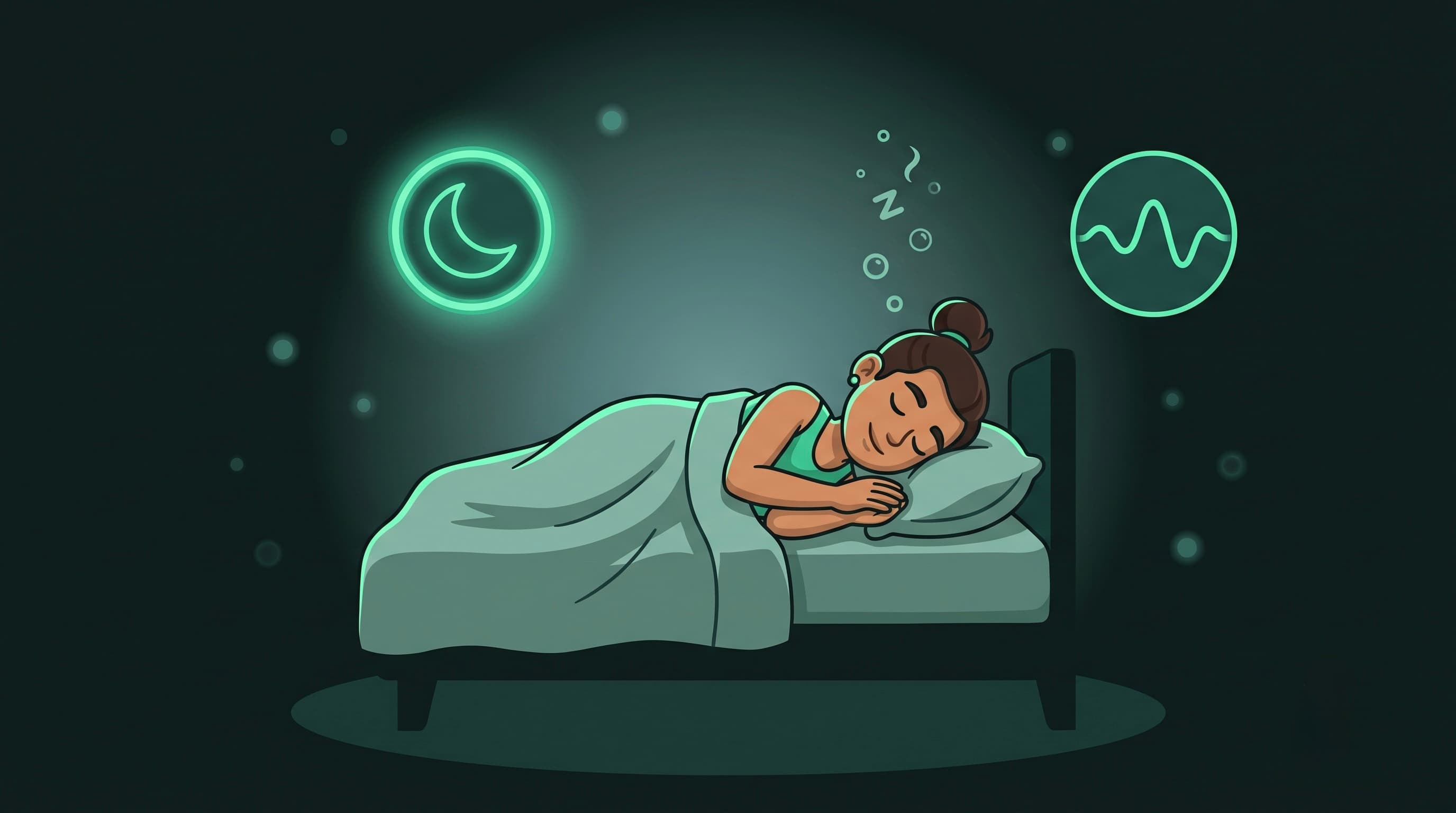
You can nail your training, your protein, and your deload timing, and still stall out if you're sleeping five hours a night. Sleep is the one recovery input with no real substitute, which is exactly why RepTrack grades it differently from everything else it measures.
Sleep is the lever, not a tiebreaker
Recovery has several inputs: heart-rate variability (HRV), resting heart rate, how hard you trained. But sleep is the one that does the actual repair work. Adults generally need about seven to nine hours a night (Hirshkowitz et al. 2015), and the deep and REM portions of that time are when most of your physical and mental recovery happens.
You can't supplement your way around it, and you can't "push through" a sleep deficit the way you can grind out a tough set. Miss enough of it and every other recovery signal starts to slide with it. That's why, of all the things you can influence day to day, sleep is the highest-leverage one you actually control.
The one place RepTrack refuses to grade on a curve
Here's the part most recovery apps get wrong.
Your HRV, resting heart rate, and other physiological signals are scored relative to your own 30-day baseline: a 70 means "right where you normally sit." That's the correct approach for those signals, because what's healthy for you isn't a population number. (The flagship article, "How Your Recovery Score Actually Works," walks through the baseline math in full.)
Sleep is the deliberate exception. RepTrack scores your sleep absolutely, against fixed targets, roughly eight hours of duration plus efficiency and the restorative deep-plus-REM fraction, not against your personal average.
Why break the pattern? Because sleep debt must never be allowed to normalize. If sleep were graded on your own curve, a chronic five-hour sleeper's five-hour night would read as "normal for you" and score fine. That's exactly backwards. Five hours isn't fine: it's a deficit whether or not you've gotten used to it. Grading sleep against a personal baseline would teach the number to lie to the person who most needs to hear the truth. So RepTrack holds sleep to a fixed bar. If you're consistently under it, your score says so, every day, until you fix it.
What's actually happening while you sleep
Your watch breaks the night into stages, and each does a different job:
- Deep sleep (slow-wave). The heavy physical-repair phase: growth-hormone release, tissue repair, the stuff that matters most after a hard lift. It's front-loaded into the first half of the night.
- REM sleep. Dreaming, memory consolidation, mental recovery, and motor-skill learning. It's weighted toward the second half of the night, which is precisely the part you amputate when you cut a night short.
- Core (light) sleep. The connective tissue of the night. It's the largest share and handles the transitions between deeper stages. Not "junk" sleep, you need it, but it isn't where the deepest restoration happens.
- Awake. Brief wakeful moments. Yes, your watch counts these. No, seeing them is not a problem, more on that below.
Deep and REM are the two stages RepTrack weighs most heavily, because those are the ones doing the real physical and cognitive repair (National Sleep Foundation).
Efficiency and restorative fraction, in plain English
Two terms show up in your sleep detail, and they're simpler than they sound.
Efficiency is the share of your time in bed that you actually spent asleep. Lie down at 11, drift off at 11:20, wake a couple of times, get up at 7: efficiency is your asleep-time divided by the whole in-bed window. High efficiency means you're sleeping solidly through the window you gave yourself. Low efficiency means you're spending a lot of the night in bed but not actually asleep.
Restorative fraction is the share of your sleep spent in deep + REM, the two repair-heavy stages. Eight hours of mostly light sleep, with almost no deep or REM, is not the same eight hours as a night rich in both. The restorative fraction is how RepTrack tells those two nights apart instead of rewarding raw time in bed.
A few awakenings are normal, really
If your sleep graph shows several short "awake" bars, don't panic. Healthy sleep is cyclical: you move through the stages roughly every 90 minutes and briefly surface between cycles. Most of those wake-ups are so short you don't even remember them.
What's worth attention is fragmented sleep: many long awakenings that wreck your efficiency. Three or four brief blips across an otherwise solid night is just what normal sleep looks like on a sensor.
How RepTrack reads your night
RepTrack doesn't measure sleep itself: it reads whatever your devices write to Apple Health. An Apple Watch gives full stage data. Many third-party wearables (Oura, Whoop, and others) write sleep too, and RepTrack uses what they provide. Whatever the source, that sleep feeds the same absolute scoring.
One detail trips people up: the night is attributed to the day you wake up. Sunday night's sleep counts toward Monday's recovery, the day it's actually preparing you for. And if a night is simply missing from Apple Health, RepTrack shows a gap rather than inventing a number. It never fabricates a score to fill a hole; that honesty contract runs through the whole engine.
How to actually move the number
Sleep hygiene isn't mystical. A handful of boring, reliable levers do most of the work:
- Protect a consistent schedule. A steady wake time every day, weekends included, does more than any single trick. Your body clock rewards regularity.
- Give yourself enough window. You can't log eight hours of sleep inside a seven-hour window. Efficiency is never 100%, so budget more time in bed than the sleep you actually want.
- Cool, dark, quiet. A cooler room supports deep sleep; darkness supports the whole cycle.
- Cut caffeine early. Caffeine has a long half-life: an afternoon coffee is still in your system at bedtime for many people, taking a direct bite out of deep sleep and efficiency.
- Wind down the last hour. Bright screens and late intense work push back sleep onset and cost you the front-loaded deep sleep you can't get back later.
- Watch late alcohol. It can help you fall asleep and then shreds your REM in the second half of the night, so the restorative fraction drops even when total time looks fine.
None of this is medical advice, and RepTrack's sleep score is a training-readiness signal, not a diagnosis. If you sleep a full night and still feel wrecked for weeks, that's a conversation for a doctor, not an app.
How sleep fits the bigger picture
When full signal is available, sleep carries 30% of your recovery score's weighting, sitting alongside HRV (the largest share), resting heart rate, and smaller respiratory-rate and temperature inputs. But it's the input with the most leverage you can act on tonight. You can't consciously raise your HRV before bed; you can go to bed. Fix sleep, and the baseline-relative signals tend to follow it upward.
For exactly how the pieces combine (the weights, the confidence rating, the green/yellow/red bands), read the flagship, "How Your Recovery Score Actually Works."
The bottom line
- Sleep does the actual repair; it's the recovery input with no substitute.
- RepTrack scores sleep absolutely, against fixed targets, not against your baseline, on purpose, so chronic sleep debt can't quietly normalize into a passing grade.
- Deep sleep rebuilds the body, REM rebuilds the mind; the restorative fraction is your deep + REM share, and efficiency is asleep-time over time-in-bed.
- A few short awakenings are normal; long, fragmented ones aren't.
- The highest-leverage fixes are boring and reliable: a consistent wake time, a big enough sleep window, a cool dark room, and early caffeine.
Sources
- Hirshkowitz M, et al. "National Sleep Foundation's Sleep Time Duration Recommendations: Methodology and Results Summary." Sleep Health, 2015.
- National Sleep Foundation: sleep stages and the restorative roles of deep (slow-wave) and REM sleep.
- RepTrack Pro recovery engine: sleep scored absolutely against fixed duration, efficiency, and deep + REM restorative-fraction targets; night attributed to the wake day; sleep read from Apple Health (Apple Watch and supported third-party wearables); missing nights shown as gaps, never fabricated.