The Cutting Guide: How to Lose Fat and Keep Your Muscle
11 min read · May 2025 · by Manikanta Sirumalla
The Cutting Guide: How to Lose Fat and Keep Your Muscle
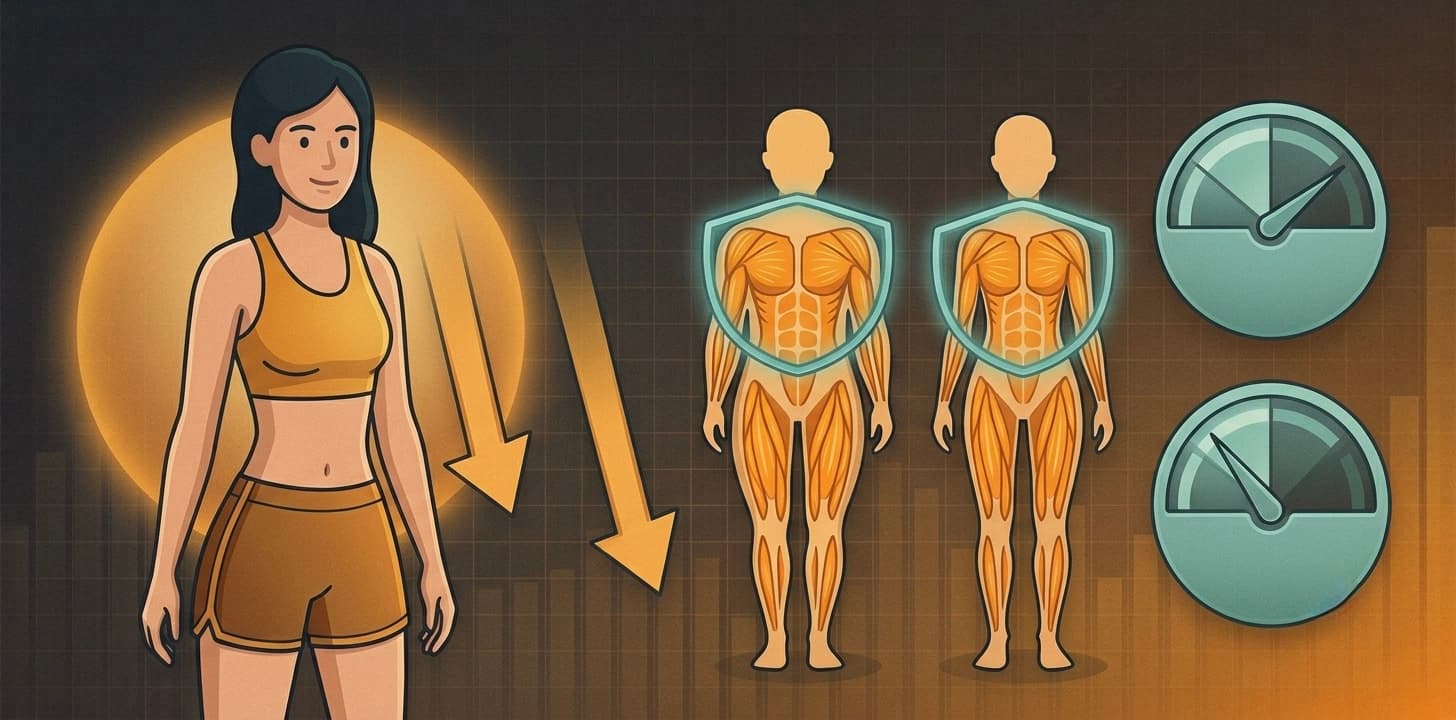
Anyone can lose weight. Eat less than you burn and the scale goes down. But losing weight is not the goal: losing fat while preserving muscle is the goal. The difference between a successful cut and a failed one is not whether the scale moved. It is what you lost. A well-executed cut strips fat while maintaining (or even slightly gaining) lean mass. A poorly executed cut burns muscle alongside fat, leaving you lighter but not leaner, just a smaller version of the same body composition.
This guide covers the complete protocol for running a proper cut: how fast to lose, how much to eat, what to do with protein, how to adjust training, and when to use strategic breaks to protect your metabolism and your sanity.
Rate of Weight Loss: How Fast Is Too Fast?
The rate at which you lose weight determines the ratio of fat-to-muscle loss. Lose too fast and muscle catabolism accelerates. Lose too slowly and the cut takes so long that adherence suffers.
The evidence-based sweet spot: 0.5-1.0% of body weight per week.
For a 180 lb person, that is 0.9-1.8 lbs per week. For a 140 lb person, it is 0.7-1.4 lbs per week. Expressing the target as a percentage of body weight automatically scales the recommendation: heavier individuals can lose more absolute weight per week; lighter individuals need to lose less.
Rate of Loss by Body Fat Level
Your current body fat percentage affects the optimal rate of loss. Leaner individuals need to lose more slowly to protect muscle.
| Body Fat (Men) | Body Fat (Women) | Max Weekly Loss | Rationale |
|---|---|---|---|
| 20%+ | 30%+ | 1.0% BW/week | Large fat reserves provide ample energy; muscle loss risk is low |
| 15-20% | 25-30% | 0.7-0.8% BW/week | Moderate fat reserves; moderate deficit is safer |
| 12-15% | 22-25% | 0.5-0.7% BW/week | Getting lean; aggressive deficits now risk muscle loss |
| Below 12% | Below 22% | 0.3-0.5% BW/week | Low body fat; fat stores cannot sustain a large deficit without muscle catabolism |
A 2011 study by Garthe et al. directly compared fast (1.4% BW/week) versus slow (0.7% BW/week) rates of weight loss in elite athletes. The slow group gained 2.1% lean body mass while losing fat. The fast group lost 0.2% lean body mass. Same total weight loss, radically different composition of that loss.
Sizing Your Caloric Deficit
Your deficit is the difference between your Total Daily Energy Expenditure (TDEE) and your actual calorie intake. The size of the deficit determines the rate of loss, and the composition of your diet within that deficit determines what you lose.
Deficit Recommendations
| Deficit Size | Calories Below TDEE | Weekly Loss (approx.) | Best For |
|---|---|---|---|
| Conservative | 250-350 cal | 0.5 lb/week | Already lean, prioritizing muscle retention |
| Moderate | 400-600 cal | 0.75-1.0 lb/week | Most people, most of the time |
| Aggressive | 700-1000 cal | 1.0-1.5 lbs/week | Higher body fat, short-term mini-cuts |
For most people, a moderate deficit of 400-600 calories below TDEE is optimal. It produces meaningful weekly fat loss without crushing training performance, triggering excessive hunger, or causing disproportionate muscle loss.
A Worked Example
Sarah is 160 lbs, 28% body fat, intermediate lifter. Her TDEE is 2,200 calories.
Target deficit: 500 calories (moderate) Daily calorie target: 2,200 - 500 = 1,700 calories Expected weekly loss: ~1.0 lb/week (0.63% BW, well within the safe range)
Duration: Sarah has 44.8 lbs of fat. If she wants to reach 22% body fat (approximately 33 lbs of fat at a projected weight of ~150 lbs), she needs to lose roughly 10-12 lbs of fat. At 1 lb/week, that is 10-12 weeks.
Protein During a Cut: Higher Than You Think
Protein is the most critical macronutrient during a cut. It serves three essential functions:
- Muscle preservation. Protein provides the amino acids needed to maintain and repair muscle tissue during a caloric deficit.
- Satiety. Protein is the most satiating macronutrient per calorie, reducing hunger during a cut.
- Thermic effect. Protein has a thermic effect of 20-30% (meaning 20-30% of protein calories are burned during digestion) versus 5-10% for carbs and 0-3% for fat.
Target: 1.0-1.3 g per pound of body weight per day during a cut.
This is higher than the bulking recommendation of 0.8-1.0 g/lb. The increased protein requirement during a cut is well-supported by research:
- A 2014 meta-analysis by Helms et al. recommended 1.0-1.4 g/lb for lean, resistance-trained athletes during caloric restriction
- The Longland et al. (2016) study showed that 1.1 g/lb during an aggressive 40% deficit resulted in lean mass gain, while 0.55 g/lb resulted in lean mass maintenance at best
- A 2018 study by Hector and Phillips in Frontiers in Nutrition concluded that protein needs increase by 50-100% during a caloric deficit to offset the increased rate of amino acid oxidation
Remaining Macros
After setting protein, allocate the remaining calories:
Fat: 0.25-0.35 g per pound of body weight. This is the floor for hormonal health. Going below 0.25 g/lb for extended periods can suppress testosterone (in men) by 10-15% and disrupt menstrual function (in women).
Carbohydrates: Fill the remaining calories with carbs. Carbs fuel your training sessions, and since workout performance is already compromised by the deficit, you need every gram you can get.
Sarah's macros at 1,700 calories:
- Protein: 160 x 1.1 = 176 g (704 cal)
- Fat: 160 x 0.3 = 48 g (432 cal)
- Carbs: (1,700 - 704 - 432) / 4 = 141 g (564 cal)
Training Modifications During a Cut
The number one training mistake during a cut is reducing intensity (weight on the bar) and switching to high-rep "toning" workouts. This is backwards. The signal that told your body to build muscle is the same signal that tells it to keep muscle. If you reduce the intensity of that signal, your body has less reason to maintain the muscle tissue.
Principles
-
Maintain intensity (weight on the bar). Your primary goal is to lift the same weights you lifted during your bulk. If you were squatting 275 lbs for 5 reps, fight to keep squatting 275 lbs for 5 reps. Accepting a small decline (5-10%) late in a cut is normal. Voluntarily dropping weight is not.
-
Reduce volume by 30-50%. Recovery capacity is reduced during a caloric deficit. You cannot handle the same training volume. Cut sets, not weight. If you were doing 16 sets of chest per week, reduce to 8-12.
-
Prioritize compound movements. Compound lifts produce the strongest muscle-retention signal per unit of time and recovery cost. Isolation work can be reduced first.
-
Train 3-4 days per week minimum. Maintain training frequency. Each session reminds your body that the muscle is needed.
-
Keep rest periods adequate. Do not shorten rest periods to "burn more calories." Rest 2-3 minutes between heavy compound sets. Under-recovery between sets reduces the weight you can lift, which reduces the muscle-retention stimulus.
Sample Cut Training Template (Upper/Lower, 4 days)
Upper A:
- Bench press: 3 x 5-8
- Barbell row: 3 x 6-8
- Overhead press: 3 x 8-10
- Pull-ups or lat pulldown: 2 x 8-10
- Face pulls: 2 x 12-15
Lower A:
- Squat: 3 x 5-8
- Romanian deadlift: 3 x 8-10
- Leg press: 2 x 10-12
- Leg curl: 2 x 10-12
- Calf raises: 3 x 12-15
Diet Breaks: The Reset Button
A diet break is a planned period of 1-2 weeks where you return to maintenance calories. It is not a "cheat week." It is a strategic physiological and psychological intervention.
Why Diet Breaks Work
During a prolonged caloric deficit, your body adapts to conserve energy. This is called adaptive thermogenesis: your TDEE decreases beyond what weight loss alone would predict. Mechanisms include:
- Reduced non-exercise activity thermogenesis (NEAT): you fidget less, move less spontaneously, and generally become more sedentary without realizing it
- Reduced thermic effect of food (you are eating less, so less energy is spent digesting)
- Hormonal shifts: leptin decreases (increasing hunger), ghrelin increases (also increasing hunger), thyroid hormone (T3) decreases (lowering metabolic rate)
A 2018 study (the MATADOR study by Byrne et al.) compared continuous dieting to intermittent dieting with 2-week diet breaks every 2 weeks. The intermittent group lost significantly more fat (14.1 kg vs. 9.1 kg), retained more lean mass, and experienced less metabolic adaptation.
Diet Break Protocol
- Frequency: Every 4-8 weeks of continuous dieting, take a 7-14 day break
- Calories: Return to estimated maintenance (add back the deficit calories)
- Protein: Keep at 0.8-1.0 g/lb
- Carbs and fat: Increase carbs preferentially. Carbohydrate refeeding restores leptin levels more effectively than fat
- Training: Maintain normal training. You may find you are stronger during the break. This is expected
- Mindset: This is not "falling off the wagon." This is planned, strategic, and evidence-based
Your scale weight will jump 2-5 lbs within the first few days of a diet break. This is glycogen and water, not fat. It takes approximately 3,500 excess calories above maintenance to gain 1 lb of fat. A week at maintenance adds zero fat.
Refeed Days: The Mini Reset
A refeed day is a single day within the cut where you increase calories to maintenance or slightly above, primarily through carbohydrates. It is a smaller version of a diet break, used between full breaks.
Refeed Protocol
- Frequency: 1-2 times per week, especially useful when body fat drops below 15% (men) or 25% (women)
- Calories: Maintenance or up to 10% above maintenance
- Carb increase: Add 50-100 g of carbohydrates beyond your deficit target
- Fat: Keep low on refeed days: prioritize carbs
- Timing: Place refeeds on your hardest training days to fuel performance
- Protein: Keep unchanged
Refeeds modestly restore leptin and glycogen, improve training performance, and provide a psychological break from the deficit. They are not as effective as full diet breaks for reversing metabolic adaptation, but they are useful for day-to-day adherence.
When to End the Cut
A cut should end when one of the following occurs:
- You reach your target body fat percentage. The primary goal has been achieved.
- The cut has lasted 12-16 weeks. Extended cuts beyond this timeframe produce diminishing returns as metabolic adaptation compounds and adherence erodes.
- Performance is significantly declining. If your lifts have dropped more than 10-15% from pre-cut levels, you are likely losing muscle.
- Psychological adherence is failing. If you cannot sustain the deficit, it is better to transition to maintenance than to cycle between restriction and binge eating.
After ending a cut, reverse diet back to maintenance over 2-4 weeks by adding 100-150 calories per week. Do not jump straight into a surplus. Allow your metabolism and hormones to normalize at maintenance for at least 4-8 weeks before beginning a lean bulk.
Common Cutting Mistakes
- Deficit too large. A 1,000+ calorie deficit accelerates muscle loss and triggers aggressive metabolic adaptation. You lose weight faster but end up with worse body composition.
- Protein too low. Below 0.8 g/lb during a cut, muscle protein synthesis cannot keep pace with protein breakdown. Muscle loss accelerates.
- Dropping training intensity. Switching to light weights and high reps removes the stimulus that preserves muscle. Keep the weight on the bar.
- Excessive cardio. Adding daily 60-minute cardio sessions on top of a caloric deficit creates too large an energy drain. Use cardio sparingly: 2-3 moderate sessions per week is sufficient.
- No diet breaks. Pushing through 16+ weeks without a break maximizes metabolic adaptation and minimizes adherence. Plan breaks proactively.
- Judging success by scale weight alone. The scale cannot distinguish fat loss from muscle loss. Track waist circumference, progress photos, and strength alongside weight.