Training During Your Period: What the Science Actually Says
7 min read · April 2025 · by Manikanta Sirumalla
Training During Your Period: What the Science Actually Says
A 2022 survey by Strava found that 78% of female athletes reported reducing or skipping exercise during menstruation. When asked why, the most common reasons were pain, fatigue, and a general assumption that training during your period is either harmful or pointless. The research says otherwise. Exercise during menstruation is not only safe for the vast majority of people — it is one of the most effective non-pharmacological interventions for reducing the very symptoms that make women skip the gym in the first place.
That does not mean you should white-knuckle through a max-effort deadlift session while doubled over with cramps. It means the binary choice between "train normally" and "skip entirely" ignores a wide middle ground that the evidence strongly supports.
What Is Happening In Your Body During Menstruation
The menstrual phase (days 1 through 5 of your cycle) is defined by the shedding of the uterine lining. Hormonally, it is the quietest phase of the cycle. Both estrogen and progesterone are at their lowest levels, having dropped sharply at the end of the previous luteal phase. Follicle-stimulating hormone (FSH) begins a slow rise as the next cycle's follicle development starts.
This hormonal low point has several implications for training:
Joint laxity decreases. Estrogen increases ligament laxity, and since estrogen is at its nadir during menstruation, your connective tissues are actually at their most stable. The ACL injury risk that peaks around ovulation (when estrogen is highest) is at its lowest right now. From a structural standpoint, this is one of the safer phases for heavy loading.
Inflammation increases. Prostaglandins — the compounds responsible for uterine contractions and cramps — also increase systemic inflammation. This can affect perceived recovery and contribute to the general "heavy" feeling many women report during days 1 and 2. Low estrogen, which normally has anti-inflammatory properties, compounds this effect.
Thermoregulation normalizes. The progesterone-driven elevation in core temperature that makes the luteal phase uncomfortable for intense exercise is now gone. Your body regulates heat normally, which means cardiovascular work feels more natural and you can sustain effort at lower heart rates compared to the previous week.
Fuel utilization shifts. Without progesterone pushing your metabolism toward fat oxidation, your body returns to efficient carbohydrate burning. This is relevant for training: glycogen-fueled, high-intensity work becomes metabolically easier compared to the late luteal phase.
The net picture is more nuanced than "everything is worse." Some things are worse (cramps, inflammation, fatigue), some things are neutral (strength), and some things are actually better (joint stability, thermoregulation, carb metabolism). Understanding this balance is what makes smart training decisions possible. For a full breakdown of all four phases, our menstrual cycle training guide covers the complete picture.
Exercise as a Pain Intervention
The strongest argument for training during your period is not about gains — it is about symptom relief. Dysmenorrhea (painful periods) affects an estimated 45 to 95% of menstruating women, depending on the study and how severity is defined. The mechanism: excess prostaglandin production causes uterine smooth muscle to contract intensely, reducing blood flow and oxygen to the uterine tissue, producing the familiar cramping pain.
Exercise counteracts this through several pathways:
-
Endorphin release. Beta-endorphins are endogenous opioids that directly raise pain threshold. Moderate-intensity exercise produces a significant endorphin response within 20 to 30 minutes. A 2018 systematic review in the Journal of Physiotherapy analyzing 12 randomized controlled trials found that regular exercise reduced menstrual pain intensity by 25 to 30% compared to no exercise.
-
Increased pelvic blood flow. Exercise promotes vasodilation throughout the body, including the pelvic region. Improved blood flow to the uterus reduces ischemia (oxygen deprivation) that contributes to cramping.
-
Reduced prostaglandin sensitivity. Regular exercisers tend to produce lower levels of prostaglandins and show reduced sensitivity to their effects. This is a chronic adaptation — the more consistently you train through your cycle, the less severe your menstrual pain tends to become over time.
-
Cortisol and mood regulation. The hormonal low point of menstruation can contribute to mood dips. Exercise-induced cortisol modulation and serotonin production help buffer against the irritability and low mood that often accompany the first few days of the cycle.
The key word in all of this research is moderate. The studies showing benefit consistently used moderate-intensity exercise — not maximal effort, not competitive sport, not high-volume training. Think 60 to 70% of your maximum effort. Enough to break a sweat and elevate your heart rate, not enough to leave you on the floor gasping.
What to Do: Exercise Selection and Intensity
Your capacity does not reliably drop just because you are bleeding — McNulty et al. (2020) found no consistent reduction in strength across the cycle, and the strongest current synthesis agrees the phase effect is small or inconsistent. So the guiding question is not "what phase am I in?" but "how do I feel today?" On days you feel good, train the way you normally would. On days cramps or fatigue bite, the options below relieve symptoms without you losing anything.
Prioritize These When Symptoms Hit
Moderate compound movements. Squats, deadlifts, presses, and rows in the 8-to-12 rep range recruit large muscle groups and produce a strong endorphin response. If cramps or fatigue are making a heavy day feel rough, easing the load to around 60 to 75% of your one-rep max keeps the stimulus while lowering the strain — that is a response to how you feel, not a rule for the calendar. If you feel fine, there is no reason to back off the weight at all.
Walking. Underrated and highly effective. A 2019 study in the Journal of Education and Health Promotion found that 30 minutes of brisk walking three times per week significantly reduced both the intensity and duration of menstrual pain. Walking increases pelvic blood flow without the impact stress of running or jumping.
Yoga and mobility work. Specific yoga poses — particularly those involving gentle hip opening and spinal extension — have been shown to reduce menstrual discomfort. Cat-cow, child's pose, supine twists, and reclined bound angle pose are commonly cited. A 2017 randomized trial found that women who practiced yoga regularly during menstruation reported 40% less pain and 60% less distress compared to the control group.
Moderate steady-state cardio. Cycling, swimming, or elliptical work at 60 to 70% of your maximum heart rate. Your body handles this type of work well during menstruation because thermoregulation is normalized and carbohydrate metabolism is efficient. Swimming has the added benefit of water pressure providing gentle compression on the abdomen.
Be Cautious With
Heavy one-rep maxes and low-rep strength work. Your maximal strength is not necessarily impaired — McNulty et al. (2020) found no consistent reduction in peak force output during menstruation. But if increased fatigue, higher perceived exertion, or cramp-related core instability are present on a given day, that is not the day to chase a personal record. If none of that is bothering you, a heavy day is fair game — the calendar alone is not a reason to hold back.
High-impact plyometrics. Box jumps, jump squats, and bounding create significant abdominal pressure increases. For some women, this exacerbates cramping and discomfort. If you tolerate these well, no need to remove them. If you do not, swap them for lower-impact alternatives like step-ups or sled pushes.
High-volume HIIT sessions. Extended high-intensity interval work (30+ minutes) can spike cortisol, which is already managing the inflammatory stress of menstruation. Shorter HIIT sessions (under 15 minutes) are fine for most people. Longer sessions may leave you more fatigued than the same workout would during the follicular phase.
Inversions and heavy abdominal work. This is more about comfort than physiology. Hanging leg raises, GHD sit-ups, and inverted positions can feel uncomfortable during heavy flow days. Substitute with planks, Pallof presses, or other anti-extension core work.
Easing By Symptoms, Not By the Calendar
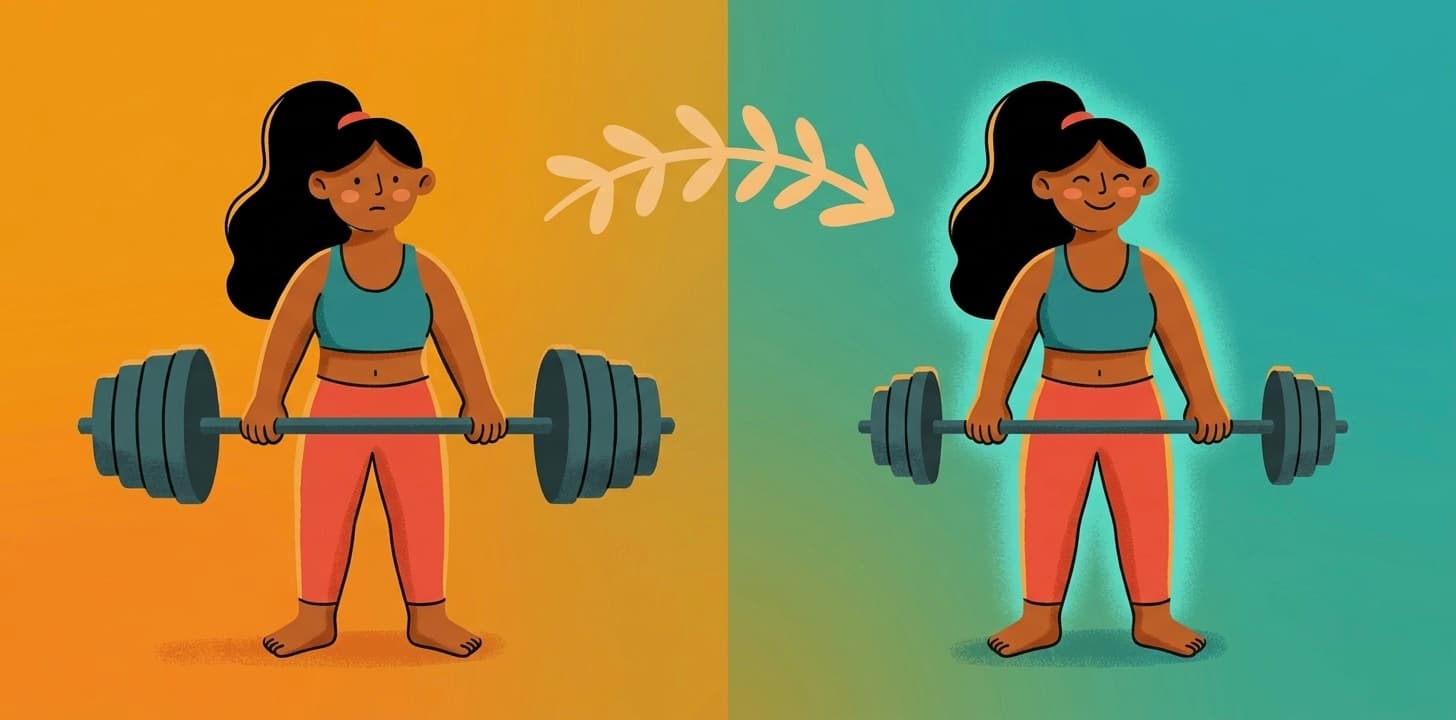
You do not need to pencil in a deload just because your period arrived. There is no reliable performance drop to program around, and pre-scheduling lighter weeks by phase means backing off on days you might have felt great. The better move is to let the symptoms you actually log — and your day-to-day readiness — decide when to ease.
When cramps, heavy fatigue, or poor sleep do stack up, a lighter session is a sensible response. What that looks like:
- Volume: Trim total sets by 20 to 30% on a rough day. If you normally do 5 sets of squats, 3 to 4 is plenty when you are not feeling it.
- Intensity: Drop to 60 to 75% of your one-rep max. Moderate weight, moderate reps, still a real training stimulus.
- Session duration: Keep it to 45 to 50 minutes so total stress stays down without skipping the work entirely.
- Frequency: Swapping a lifting day for a walk or some active recovery is fine on the days symptoms are loud.
None of this is detraining, and none of it is mandatory. Short-term (5 to 7 day) reductions in volume do not impair strength or muscle mass, especially when intensity is maintained — so easing on a bad day costs you nothing. But the trigger is how you feel, not the date on the calendar. On the days you feel good, train hard.
For a deeper look at how nutrition changes across the luteal phase leading into menstruation, our luteal phase nutrition guide covers the calorie and macro adjustments that support this training approach.
When to Actually Skip
There are legitimate reasons to take a full rest day during menstruation. Not every situation calls for pushing through:
- Severe dysmenorrhea that does not respond to moderate movement. If a 15-minute walk makes cramps worse rather than better, rest is the right call. This affects roughly 10 to 15% of menstruating women.
- Menorrhagia (extremely heavy bleeding). Women who soak through a pad or tampon every hour for several consecutive hours may experience iron depletion significant enough to impair exercise tolerance. Prioritize iron-rich foods and rest.
- Fever or illness coinciding with menstruation. Your immune function is slightly suppressed during the menstrual phase. If you are fighting an infection at the same time, rest wins.
- Sleep deprivation. If cramps or discomfort kept you awake, a recovery day is more productive than a training session performed on under 5 hours of sleep. Our rest days guide covers how to make recovery days genuinely productive.
The distinguishing factor is whether you feel low-energy (which usually improves with movement) versus whether you feel genuinely unwell (which usually does not). Low energy is a signal to train at reduced intensity. Feeling unwell is a signal to rest.
Building a Long-Term Pattern
The first cycle where you consciously train through menstruation will feel like an experiment. By the third cycle, you will start seeing patterns. Maybe day 1 is always a write-off but day 3 feels surprisingly good. Maybe walking helps cramps more than yoga does for your body specifically. Maybe you discover that your strength on day 4 of menstruation is nearly identical to the follicular phase.
These individual patterns are more valuable than any generalized protocol. Track what you do, how you feel, and how you perform. Over three to four cycles, your personal playbook will be far more useful than population averages. Log your energy level, cramp severity, exercise type, and post-workout mood. The data accumulates into a strategy that is genuinely yours.