Luteal Phase Nutrition: What the Evidence Really Says About Calories and Cravings
8 min read · April 2025 · by Manikanta Sirumalla
Luteal Phase Nutrition: What the Evidence Really Says About Calories and Cravings
Around the middle of your cycle, something measurable happens: progesterone becomes the dominant hormone after ovulation, and it is thermogenic — it raises your core body temperature by roughly 0.3 to 0.5 degrees Celsius. Some indirect-calorimetry studies find this coincides with a modest rise in resting metabolic rate, often quoted as an extra 100 to 300 calories per day. But that range is wide for a reason: the effect is small, varies a lot between individuals, and several studies find no meaningful difference at all. It is not a fixed calorie debt your body is owed, and it is not a signal to pre-schedule extra food by the calendar. What you actually notice is more individual — cravings, fatigue, or irritability for some; very little for others.
This is the phase where most women feel like their nutrition plan is falling apart. Usually it is not falling apart, and it does not need a special "luteal diet." It needs you to keep eating to your targets while paying attention to the symptoms you actually experience.
The Metabolic Shift: What Progesterone Does to Your Energy Systems
Progesterone does more than raise your temperature. It fundamentally changes how your body processes fuel. During the follicular phase, your body preferentially burns glycogen (stored carbohydrates) for energy, especially during exercise. Estrogen supports this carbohydrate-dominant metabolism and enhances insulin sensitivity, meaning your cells respond efficiently to insulin and clear glucose from your blood quickly.
The luteal phase flips this equation. Progesterone reduces insulin sensitivity by roughly 15 to 20%, meaning your cells become less responsive to insulin. Blood sugar fluctuates more. Your body shifts toward greater fat oxidation at rest, which sounds like a good thing — and it is, for steady-state energy — but it means carbohydrate metabolism becomes less efficient precisely when most women are craving carbs.
Here is the honest core of luteal-phase nutrition: carbohydrate metabolism shifts modestly, cravings can get louder, and symptoms vary enormously from person to person. The answer is not a scheduled calorie bump, and it is not white-knuckling through cravings. It is eating to your targets, honoring genuine hunger when it shows up, and answering cravings intelligently rather than fighting or feeding them blindly.
How big is that metabolic increase, really? Early work (Webb, 1986) and some later studies put it around 150 to 200 kcal per day mid-luteal (around days 21 to 25); other studies find little or no reliable difference, and the strongest current syntheses treat the average effect as small and inconsistent. The practical takeaway is not to bolt a fixed number onto your calorie target by the calendar. Eat to your computed macros, and let genuine hunger — not the date — tell you when your body actually wants more. If a mid-luteal training day leaves you hungrier, adding some carbohydrate around that session is a reasonable, optional response.
Carbohydrates: The Right Ones, At the Right Time
Since insulin sensitivity drops during the luteal phase, the type and timing of carbohydrates matters more than it does during the rest of your cycle. High-glycemic carbohydrates — white bread, sugary snacks, fruit juice — cause sharper blood sugar spikes that your now-less-responsive cells struggle to manage. The result is a rapid spike followed by a crash, which triggers more cravings, more fatigue, and more mood instability.
Complex carbohydrates with a lower glycemic index solve this problem. They release glucose slowly, keeping blood sugar stable over hours instead of minutes. The practical swap list:
| Instead of | Choose |
|---|---|
| White rice | Brown rice or quinoa |
| White bread | Whole grain or sourdough |
| Sugary cereal | Oats with berries |
| Chips or crackers | Sweet potato wedges |
| Candy or chocolate bars | Dark chocolate (70%+) with nuts |
Sweet potatoes deserve special mention. They are rich in complex carbohydrates, contain meaningful amounts of vitamin B6 (which we will get to), and have a moderate glycemic index of around 63 when boiled. Oats are another powerhouse — high in beta-glucan fiber, which slows digestion and stabilizes blood sugar effectively.
If you want to lean into complex carbs during this phase, keep it optional and anchored to training, not to the calendar. Some women find that a little extra carbohydrate on luteal training days — on the order of 0.75 g per kg of bodyweight, sourced from complex carbs — helps with energy and cravings. Protein stays stable; fat stays at or slightly above baseline. Treat this as a preference to test on yourself, not a rule: if you feel fine on your normal targets, there is nothing to change.
Micronutrients That Actually Matter in This Phase
Three micronutrients become significantly more important during the luteal phase, and all three are commonly under-consumed.
Magnesium
Magnesium levels drop measurably during the luteal phase. This is relevant because magnesium is involved in over 300 enzymatic reactions in the body, including muscle contraction, nervous system regulation, and serotonin production. Low magnesium is directly linked to several hallmark PMS symptoms: muscle cramps, headaches, anxiety, poor sleep, and water retention.
A 2010 study in the Journal of Women's Health found that supplementing with 250 mg of magnesium daily reduced PMS symptoms by 34% compared to placebo. The food-first approach: pumpkin seeds (156 mg per ounce), dark chocolate (64 mg per ounce), spinach (157 mg per cooked cup), almonds (80 mg per ounce), and black beans (120 mg per cooked cup). If food alone does not cover it, 200 to 400 mg of magnesium glycinate — the most bioavailable and gut-friendly form — is the standard supplemental dose.
Vitamin B6
Progesterone dominance in the luteal phase increases demand for vitamin B6 (pyridoxine), which is a cofactor in the synthesis of serotonin and dopamine. These neurotransmitters regulate mood, appetite, and sleep. When B6 is insufficient, serotonin production drops, which is one reason PMS-related mood changes, food cravings, and sleep disruption cluster in this phase.
Research shows that 50 to 100 mg of B6 daily during the luteal phase can reduce symptoms of PMS-related depression and irritability. Food sources include chicken breast (0.5 mg per 3 oz), salmon (0.6 mg per 3 oz), chickpeas (1.1 mg per cup), bananas (0.4 mg each), and potatoes (0.4 mg per medium potato). The tolerable upper limit is 100 mg per day from supplements — exceeding this chronically can cause nerve damage, so more is not better here.
Calcium
Often overlooked in the PMS conversation, calcium plays a documented role in reducing luteal-phase symptoms. A large randomized controlled trial published in the American Journal of Obstetrics and Gynecology found that 1,200 mg of calcium daily reduced overall PMS symptoms by 48% over three menstrual cycles. Dairy, fortified plant milks, sardines, and leafy greens are the primary food sources.
Sodium, Bloating, and the Scale
Progesterone promotes aldosterone secretion, which causes your kidneys to retain more sodium and water. This is why the scale can jump 2 to 5 pounds during the luteal phase — and why that number is not fat gain. It is fluid.
The instinct is to slash sodium intake, but going too low (under 1,500 mg per day) can backfire. Your body responds to very low sodium by increasing aldosterone further, which paradoxically increases water retention. The smarter approach: keep sodium at a moderate, consistent level (2,000 to 2,500 mg per day), increase your water intake to 2.5 to 3 liters per day, and eat potassium-rich foods (bananas, avocados, potatoes, spinach) that help balance sodium's fluid-retention effects.
Do not weigh yourself during the late luteal phase expecting a meaningful number. If you are tracking body composition, use your early-to-mid follicular phase weight as your true baseline. The luteal-phase number is noise, not signal. For more context on what body composition metrics actually matter, our cycle training guide covers how performance and body metrics shift across the full cycle.
Cravings Are Not Weakness — They Are Data
The chocolate craving that hits around day 22 of your cycle is not a lack of willpower. It is a hormonal signal with a biological basis. Serotonin levels drop during the luteal phase as progesterone rises and estrogen falls. Carbohydrates — especially sugar — trigger a temporary serotonin boost via insulin-mediated tryptophan transport across the blood-brain barrier. Your brain is literally requesting the nutrient that will restore its serotonin supply.
The problem is not the craving. The problem is responding to a serotonin deficit with a bag of candy, which spikes blood sugar, crashes it, depletes serotonin again within hours, and creates a cycle of craving and guilt. The evidence-based response:
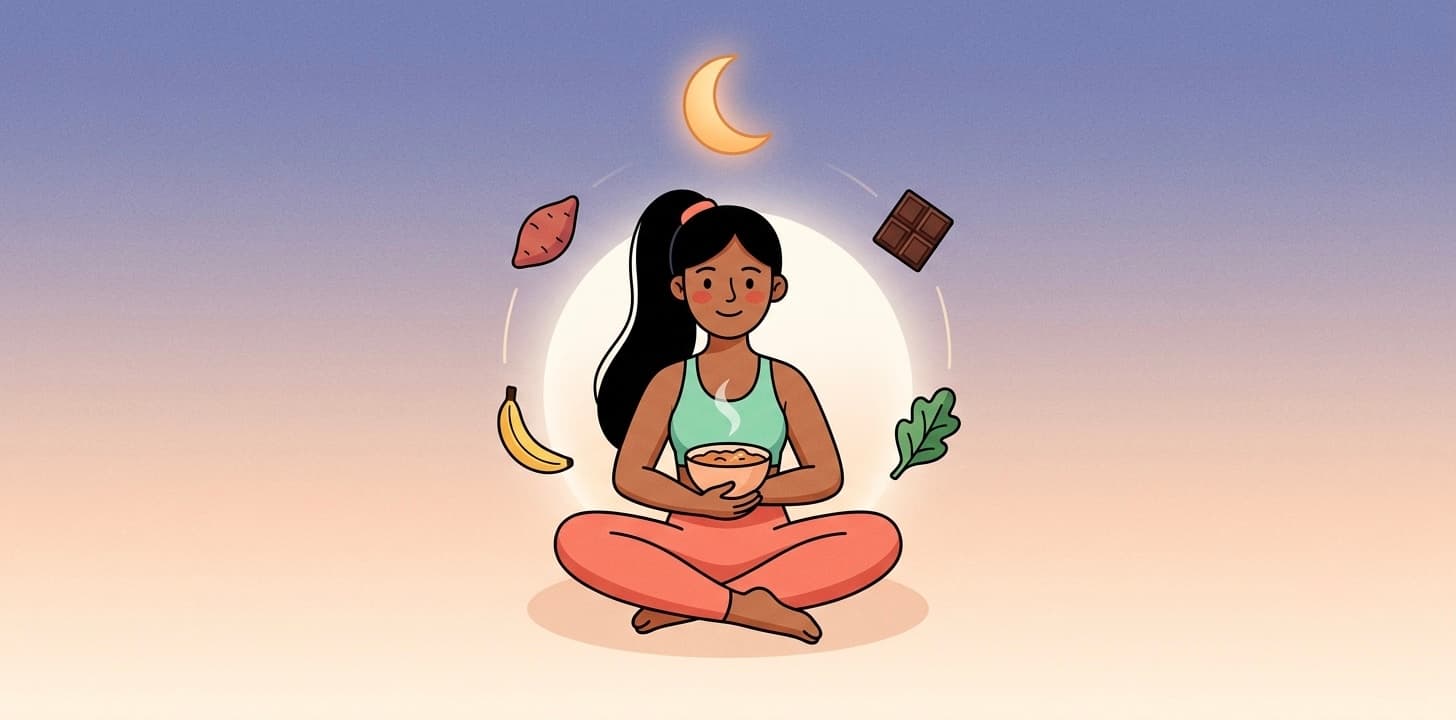
- Honor the craving with a complex-carb equivalent. A bowl of oatmeal with dark chocolate chips and banana provides the carbohydrate signal your brain needs while keeping blood sugar stable.
- Include tryptophan-rich foods. Turkey, eggs, cheese, nuts, and seeds provide the amino acid precursor for serotonin. Pair them with carbohydrates (the insulin response helps tryptophan enter the brain).
- Honor genuine hunger; don't white-knuckle severe symptoms. If you are in a fat-loss phase and hunger or symptoms spike, easing a few days closer to maintenance is fine — but drive that by how you actually feel and what you log, not by a calendar-scheduled "luteal maintenance window." Cravings and hunger are real signals worth respecting; they are not a mandate to add calories every cycle on schedule.
Practical Meal Modifications
Here is what a day of eating might look like with follicular-phase versus luteal-phase food choices — both at the same ~1,900 kcal target. Notice these are swaps, not a calorie increase:
Follicular Phase (day 8)
- Breakfast: Greek yogurt with granola and blueberries (400 kcal)
- Lunch: Grilled chicken salad with quinoa and olive oil dressing (500 kcal)
- Pre-workout: Rice cakes with peanut butter (200 kcal)
- Dinner: Salmon with white rice and steamed broccoli (550 kcal)
- Snack: Protein shake (250 kcal)
- Total: ~1,900 kcal
Luteal Phase (day 22)
- Breakfast: Oatmeal with dark chocolate, banana, and pumpkin seeds (440 kcal)
- Lunch: Turkey and avocado whole-grain wrap with spinach (480 kcal)
- Pre-workout: Sweet potato with almond butter (230 kcal)
- Dinner: Chicken thighs with brown rice, roasted vegetables, and tahini (540 kcal)
- Snack: Magnesium-rich trail mix (almonds, dark chocolate, dried cherries) (210 kcal)
- Total: ~1,900 kcal
The differences are subtle but deliberate — and they hold the same calorie total: more complex carbs, more magnesium-rich foods, and tryptophan sources at multiple meals. No calorie bump by the calendar, no special "hormone diet." Just matching your food choices to what your physiology is actually requesting on the days you feel it.
For a deeper dive into how to track these symptoms and adjustments over multiple cycles, our symptom tracking guide covers the practical logging side. The more data you collect, the more precisely you can predict which days need which adjustments — because your cycle is yours, not the textbook average.