Protein Timing: When to Eat Protein for Maximum Muscle Growth
9 min read · May 2025 · by Manikanta Sirumalla
Protein Timing: When to Eat Protein for Maximum Muscle Growth
If total daily protein intake is king, and it is, then protein distribution is the queen. You can hit 160 grams of protein per day and still leave muscle growth on the table if 100 of those grams come in a single meal while the other two meals barely clear 30 grams each. The reason comes down to a biological mechanism that most lifters have never heard of: the muscle protein synthesis refractory period.
Understanding how your body processes protein at each meal, what triggers the anabolic signal, and how long that signal lasts before it resets changes the way you think about meal planning. Not in a neurotic, weigh-every-gram way, but in a practical, "this is how biology actually works" way that adds up over months and years of training.
The Leucine Threshold: Your Anabolic Trigger
Muscle protein synthesis, the process of building new muscle tissue, is not triggered by protein in general. It is triggered primarily by the amino acid leucine. Leucine activates the mTOR signaling pathway, which is the molecular switch that tells your muscle cells to start assembling new proteins.
Research consistently shows that a minimum of approximately 2.5 to 3 grams of leucine per meal is required to maximally stimulate MPS. This is known as the leucine threshold. Below this amount, you get a partial MPS response. At or above it, you get full activation.
What does 2.5–3 grams of leucine look like in real food?
| Protein Source | Amount Needed for ~3g Leucine |
|---|---|
| Whey protein isolate | 25 g protein (~1 scoop) |
| Chicken breast | 30–35 g protein (~130 g cooked) |
| Eggs | 35–40 g protein (~5–6 whole eggs) |
| Greek yogurt | 35 g protein (~350 g) |
| Beef | 30 g protein (~130 g cooked) |
| Tofu | 40–45 g protein (~400 g) |
| Lentils | 45–50 g protein (~350 g cooked) |
Notice the disparity between animal and plant sources. Whey protein is roughly 11% leucine by weight, making it the most leucine-dense common protein. Plant proteins average 6–8% leucine, meaning you need a larger total protein serving to cross the threshold. This is one reason plant-based athletes benefit from slightly higher total protein targets: 1.8 to 2.4 g/kg versus 1.6 to 2.2 g/kg for omnivores.
The MPS Refractory Period: Why More Protein Does Not Mean More Muscle
Here is where the science gets genuinely interesting, and where it contradicts what most people assume.
After you consume a meal that crosses the leucine threshold, MPS spikes sharply and remains elevated for approximately 3 to 5 hours. After that window, MPS returns to baseline, regardless of whether amino acids are still circulating in your bloodstream. This is the refractory period.
A landmark 2012 study by Atherton and colleagues at the University of Nottingham demonstrated this clearly. They infused amino acids continuously into participants and measured MPS over time. Despite a constant supply of amino acids, MPS spiked for about 90 minutes, peaked, and then returned to baseline within 3 hours, a phenomenon they called the "muscle full" effect. The muscle cells essentially became temporarily unresponsive to the anabolic signal, even with abundant amino acid availability.
What this means practically: eating 80 grams of protein in a single meal does not produce twice the MPS response of 40 grams. Once you cross the leucine threshold and trigger full MPS activation, additional protein in that same meal does not extend or amplify the response. Those extra amino acids are oxidized for energy or converted to glucose, they are not wasted in a caloric sense, but they do not contribute to additional muscle building at that particular time point.
The refractory period resets after approximately 3 to 5 hours. At that point, your muscles become responsive to leucine again, and the next protein-containing meal can trigger a fresh MPS spike.
Protein Distribution: How to Spread It Across the Day
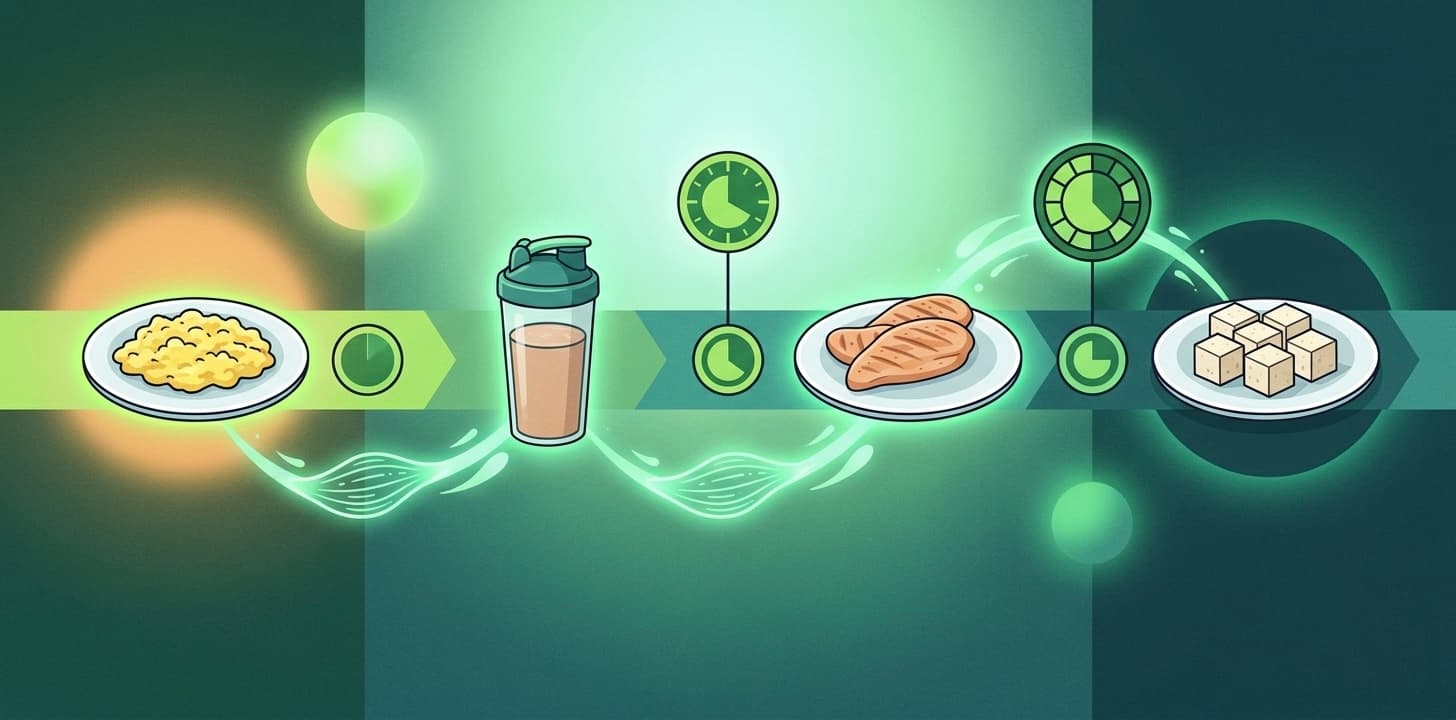
Given the leucine threshold and the refractory period, the optimal strategy becomes clear: distribute your daily protein across 3 to 5 meals, each containing enough protein to cross the leucine threshold, spaced 3 to 5 hours apart.
A 2018 meta-analysis by Schoenfeld and Aragon confirmed that distributing protein across at least 3 meals per day produced superior hypertrophy outcomes compared to consuming the same total protein in fewer, larger meals. The effect was modest, we are talking about optimizing the final 10–15% of your potential gains, but it was statistically significant and consistent across studies.
For a practical example, consider a 80 kg lifter targeting 2.0 g/kg daily protein (160 g total):
| Meal | Time | Protein | Leucine (approx.) |
|---|---|---|---|
| Breakfast | 7:00 AM | 40 g (eggs + yogurt) | ~3.2 g |
| Lunch | 12:00 PM | 40 g (chicken + rice) | ~3.4 g |
| Pre-workout snack | 3:30 PM | 30 g (whey shake) | ~3.3 g |
| Dinner | 7:00 PM | 40 g (salmon + vegetables) | ~3.2 g |
| Before bed | 10:00 PM | 10 g (casein or cottage cheese) | ~1.0 g |
| Total | 160 g |
This gives four full MPS-triggering meals and a smaller bedtime dose. The bedtime serving is deliberately below the leucine threshold here for caloric reasons, but ideally you would bump it to 30–40 grams if your calorie budget allows.
Pre-Workout Protein: Priming the Pump
Consuming protein before training ensures circulating amino acids are available during and immediately after your session. A 2017 study in the Journal of the International Society of Sports Nutrition found that pre-workout protein (consumed 1–2 hours before training) was at least as effective as post-workout protein for supporting muscle growth, and when both were consumed, the combination was marginally superior to either alone.
The practical takeaway: if you eat a protein-rich meal 1 to 3 hours before training, you have effectively "front-loaded" your post-workout nutrition. Your body does not distinguish between amino acids consumed before versus after the session: if they are circulating in your bloodstream during and after training, they are available for muscle repair.
This is why the obsession with immediately post-workout protein is largely misplaced for people who eat a normal meal schedule. If you had 35 grams of protein at lunch and started training at 2 PM, your muscles have ample amino acids available through the session and for hours afterward.
Post-Workout Protein: What the Data Actually Says
The post-exercise period does feature enhanced muscle sensitivity to amino acids, and this is real and well-documented. Resistance training increases amino acid transport into muscle cells and upregulates the molecular machinery for protein synthesis. But this enhanced sensitivity lasts for 24 to 48 hours, not 30 minutes.
Where post-workout protein urgency increases is when you train fasted. If you have not eaten for 8+ hours (morning training on an empty stomach), the combination of depleted amino acid pools and exercise-induced muscle breakdown creates a scenario where getting protein within 1 to 2 hours post-training meaningfully impacts net muscle protein balance. For detailed post-workout strategies, see our post-workout nutrition guide.
Overnight Protein: The Case for Casein
Sleep represents the longest fasting period in your day, typically 7 to 9 hours without amino acid intake. During this time, your body shifts toward a net catabolic state as muscle protein breakdown gradually exceeds synthesis.
A frequently cited 2012 study by Res et al. demonstrated that 40 grams of casein protein consumed 30 minutes before sleep increased overnight MPS by approximately 22% compared to placebo. Casein is a slow-digesting protein that forms a gel-like structure in the stomach, providing a sustained release of amino acids over 5 to 7 hours, roughly matching the duration of sleep.
Subsequent research by Snijders et al. (2015) extended this finding over a 12-week training study. Participants who consumed 27.5 grams of casein before bed gained significantly more muscle mass and strength than those who consumed a non-caloric placebo, despite both groups following the same training program.
Is a bedtime protein shake mandatory? No. If your last meal was at 8 PM and you sleep at 11 PM, you have already provided amino acids relatively close to sleep. But if you eat an early dinner (6 PM) and go to bed at 11 PM, a casein shake or serving of cottage cheese (which is naturally high in casein) bridges a 5-hour gap and provides overnight amino acid availability.
Putting It All Together
Protein timing is not the most important variable for muscle growth: total daily intake is. But once your daily totals are locked in and your macros are calculated correctly, distribution becomes the next lever you can pull.
The hierarchy, in order of impact:
- Total daily protein (1.6–2.2 g/kg for most lifters): this is non-negotiable
- Even distribution across 3–5 meals, each crossing the leucine threshold
- Pre-workout protein within 1–3 hours of training, ensures amino acid availability
- Post-workout protein within 2 hours, more urgent if training fasted
- Pre-sleep protein (casein or cottage cheese), bridges the overnight fast
Do not let the nuance paralyze you. If you are hitting your protein target across three or four real meals per day, you are capturing the vast majority of the benefit. The difference between a "perfect" protein distribution and a "pretty good" one is measured in single-digit percentage improvements over months. Focus on consistency first, optimization second.